
 Article
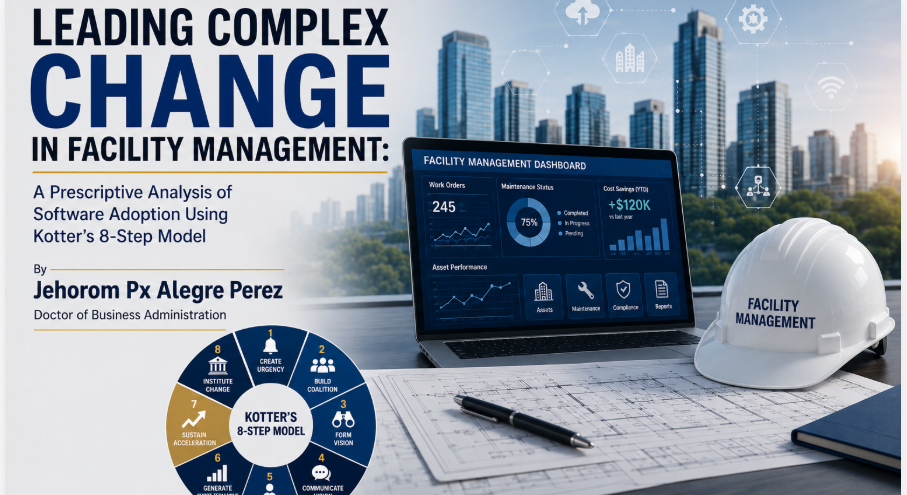
This study provides an insight and prescriptive approach in leading a complex change in a facilities management company aiming to have a technological upgrade through a purchase of Software Applications Product (SAP). The prescriptive study aims to determine the employees’ readiness to embrace change in terms of both technical and human aspects. This study provides guidance on the use of both quantitative and qualitative research methods using the theoretical framework of Kotter's 8 step model. The patterns and results from the qualitative research methods will serve as the framework for quantitative analysis in testing its generalizability. The study focuses only on prescriptive approach since the mixed methods being mentioned were not done to test the hypotheses and that the expected results were purely based on literature review pertaining to employee's resistance to change and different frameworks about leading complex changes.
Scroll to read the preview. Download for the complete document.
Ahmad, T., & Zhang, D. (2020). A critical review of comparative global historical energy consumption and future demand: The story told so far. Energy Reports, 6, 1973-1991.
Alam, T. (2020). Cloud Computing and its role in the Information Technology. IAIC Transactions on Sustainable Digital Innovation (ITSDI), 1(2), 108-115.
bin Syed Mustapa, S. A. H., Adnan, H., & Jusoff, K. (2008). Facility management challenges and opportunities in the Malaysian property sector. Journal of Sustainable Development, 1(2), P79.
Chotipanich, S. (2004). Positioning facility management. Facilities, Vol. 22, Nos. 13/14, pp. 364-372.
Chou, S. W., & Chang, Y. C. (2008). The implementation factors that influence the ERP (enterprise resource planning) benefits. Decision support systems, 46(1), 149-157.
Eastman, C. M. (2011). BIM handbook: A guide to building information modeling for owners, managers, designers, engineers and contractors. John Wiley & Sons.
Finney, S., & Corbett, M. (2007). ERP implementation: a compilation and analysis of critical success factors. Business process management journal, 13(3), 329-347.
Forbes (2022). Most Change Initiatives Fail – Here’s How to Beat The Odds. Retrieved from: https://www.forbes.com/sites/lisabodell/2022/03/28/most-change-initiatives-fail---heres-how-to-beat-the-odds/
Hiatt, J. (2006). ADKAR: a model for change in business, government, and our community. Prosci.
Hubbart, J. A. (2023). Organizational change: The challenge of change aversion. Administrative Sciences, 13(7), 162.
Irizarry, J., Gheisari, M., & Walker, B. N. (2012). Usability assessment of drone technology as safety inspection tools. Journal of Information Technology in Construction (ITcon), 17(12), 194-212.
Khaw, K. W., Alnoor, A., Al-Abrrow, H., Tiberius, V., Ganesan, Y., & Atshan, N. A. (2023). Reactions towards organizational change: a systematic literature review. Current Psychology, 42(22), 19137-19160.
Kotter, J. P. (2007). Leading change: Why transformation efforts fail. In Museum management and marketing (pp. 20-29). Routledge.
Lepkova, N. - Vilutiene, T. (2008). Pastatų ūkio valdymas: teorija ir praktika (Facilities management: theory and practice). Vilnius: Technika, 328 pp. ISBN 978-9955-28-309-6 (in Lithuanian).
Lepkova, N., & Žūkaitė-Jefimovienė, G. (2012). Study on customer satisfaction with facilities management services in Lithuania. Slovak Journal of Civil Engineering, 20(4), 1-16.
McKinsey & Company. (2020). "The need for speed in the post-COVID-19 economy." Retrieved from mckinsey.com
Mudrak, T. - Wagenberg, A. - Wubben, E. (2004). Assessing the innovative ability of FM teams: a review. Facilities, Vol. 22, Nos. 11/12, pp. 290-295.
Paramitha, T. A., Tobing, D. K., & Suroso, I. (2020). ADKAR Model to Manage Organizational Change. International Journal of Research Science and Management, 7(1), 141-149.
Perera, C., Zaslavsky, A., Christen, P., & Georgakopoulos, D. (2013). Context aware computing for the internet of things: A survey. IEEE communications surveys & tutorials, 16(1), 414-454.
Pitt, M. - Tucker, M. (2008). Performance measurement in facilities management: driving innovation? Property Management, Vol. 26, No. 4, pp. 241–254.
Piyush, R., Bhatt, R., & Pitroda, J. (2016). Study of factors affecting customer satisfaction for residential flats in Surat and Ahmedabad city in Gujarat region of India. International Research Journal of Engineering and Technology, 3(03), 1-8.
Rasila, H. M. - Gelsberg, N. F. (2007). Service quality in outsourced facility maintenance services. Journal of Corporate Real Estate, Vol. 9, No. 1, pp. 39-49.
Read, D. C., & Carswell, A. (2019). Is property management viewed as a value-added service? Property Management, 37(2), 262–274.
Sanderson, D. C., & Read, D. C. (2020). Recognizing and realizing the value of customer-focused property management. Property Management, 38(5), 749-764.
Zhou, K., Fu, C., & Yang, S. (2016). Big data driven smart energy management: From big data to big insights. Renewable and sustainable energy reviews, 56, 215-225.
Metrics are updated in real time as the article is accessed and downloaded.
Comments
Leave a Comment