
 Article
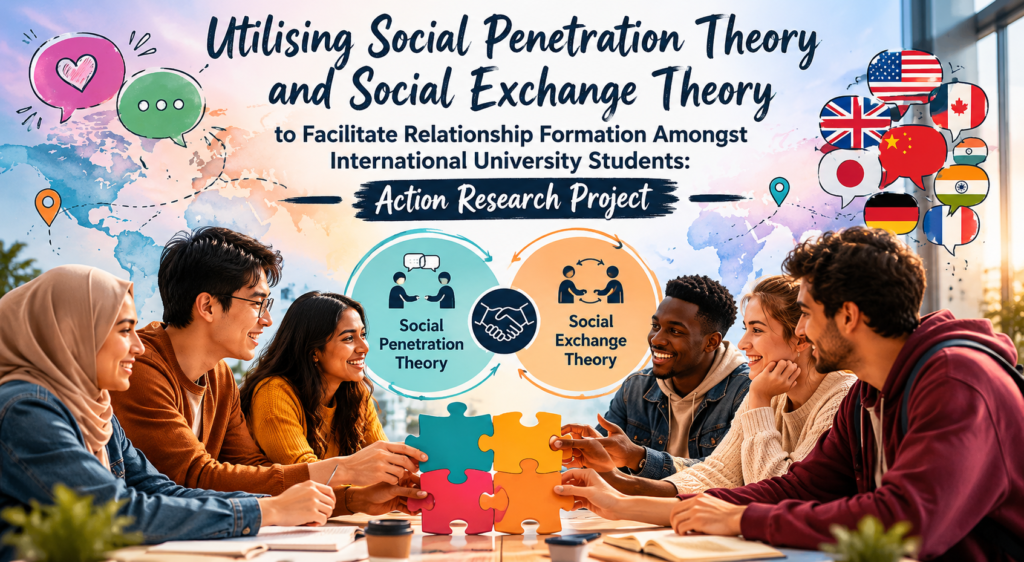
The challenges of being a stranger at a new university can be quite daunting. In most cases, the lack of social interactions with people from different cultural backgrounds undermines mental stability, class participation, and acceptance. To address this problem, an action research study was conducted grounded in Social Penetration Theory and Social Exchange Theory. Using these theories as a framework, a relevant learning activity was designed to foster relationships among international first-year undergraduate students. The action research involved planning and implementing a series of six-week workshops to develop learners' relational skills through the application of SPT and SET theories. Among other students who participated in the workshop, there were twenty-four new international undergraduate students. In the first place, the method used involved participants keeping a journal. Apart from pre- and post-questionnaires, observations were made along the way. The first change worth noticing was the level of confidence in developing relationships. Cultural differences were observed not only in language and nonverbal aspects of communication, but also in expectations regarding personal dynamics. Action research yielded several insights into the use of Western-derived theories in multicultural settings. The current action research project helps to evaluate two main sociopsychological theories, providing counselling professionals with relevant information.
Key Words: Social Penetration Theory, Social Exchange Theory, action research, international students, relationship formation
Scroll to read the preview. Download for the complete document.
Altman, I., & Taylor, D. A. (1973). Social penetration: The development of interpersonal relationships. Holt, Rinehart & Winston.
Baxter, L. A. (1988). A dialectical perspective on communication strategies in relationship development. In S. Duck (Ed.), Handbook of personal relationships (pp. 257–273). Wiley.
Berger, C. R., & Calabrese, R. J. (1975). Some explorations in initial interaction and beyond. Human Communication Research, 1(2), 99–112.
Bondarchuk, J., Dvorianchykova, S., Yuhan, N., & Holovenko, K. (2024). Strategic approaches: Practical applications of English communication skills in various real-life scenarios. Multidisciplinary Science Journal.
Bowlby, J. (1979). The bowlby-ainsworth attachment theory. Behavioral and brain sciences, 2(4), 637-638.
Crocker, J., Canevello, A., & Brown, A. A. (2017). Social motivation: Costs and benefits of selfishness and otherishness. Annual Review of Psychology, 68(1), 299–325. https://doi.org/10.1146/annurev-psych-010416-044145
Gelman, A., & Hennig, C. (2017). Beyond subjective and objective in statistics. Journal of the Royal Statistical Society Series A: Statistics in Society, 180(4), 967-1033.
Gómez-López, M., Viejo, C., & Ortega-Ruiz, R. (2019). Psychological well-being during adolescence: Stability and association with romantic relationships. Frontiers in psychology, 10, 1772.
Hargreaves, E., & Elhawary, D. (2021). Children’s experiences of agency when learning English in the classroom of a collectivist culture. System, 98, 102476.
Kemmis, S., & McTaggart, R. (2005). Participatory action research: Communicative action and the public sphere. In N. K. Denzin & Y. S. Lincoln (Eds.), The SAGE handbook of qualitative research (3rd ed., pp. 559–603). SAGE.
Kim, H., & Auh, S. (2019). The influences from comparison level and comparison level for alternatives on the dating relationship stability, and mediating effects from the commitment among the college students. Human Ecology Research, 57(1), 127–142. https://doi.org/10.6115/fer.2019.010
Knobloch, L. K., & Solomon, D. H. (2005). Relational uncertainty and relational information processing: Questions without answers? Communication Research, 32(3), 349–388. https://doi.org/10.1177/0093650205275384
McNiff, J. (2017). Action research: All you need to know. SAGE.
Mozersky, J., Parsons, M., Walsh, H., Baldwin, K., McIntosh, T., & DuBois, J. M. (2020).
Research participant views regarding qualitative data sharing. Ethics & human research, 42(2), 13-27.
Nelson, T. D., & Olson, M. A. (2023). The psychology of prejudice. Guilford Publications.
Pennington, N. (2015). Building and maintaining relationships in the digital age: Using social penetration theory to explore communication through social networking sites. International Journal of Communication, 9, 1–18.
Reis, H. T., & Shaver, P. (2018). Intimacy as an interpersonal process. In S. Duck (Ed.), Handbook of personal relationships (pp. 367–389). Wiley.
Ruppel, E. K., Gross, C., Stoll, A., Peck, B. S., Allen, M., & Kim, S. Y. (2017). Reflecting on connecting: Meta-analysis of differences between computer-mediated and face-to-face self-disclosure. Journal of Computer-Mediated Communication, 22(1), 18–34. https://doi.org/10.1111/jcc4.12179
Rusbult, C. E., Agnew, C., & Arriaga, X. (2011). The investment model of commitment processes. In P. A. M. Van Lange, A. W. Kruglanski, & E. T. Higgins (Eds.), Handbook of theories of social psychology (Vol. 2, pp. 218–231). SAGE.
Smithson, J. (2025). Self-disclosure. In O. Hargie (Ed.), The handbook of communication skills (pp. 273–310). Routledge.
Sprecher, S., Wenzel, A., & Harvey, J. (2018). Self-disclosure and starting a close relationship. In S. Sprecher, A. Wenzel, & J. Harvey (Eds.), Handbook of relationship initiation (pp. 164–185). Psychology Press.
Stafford, L. (2020). Communal strength, exchange orientation, equity, and relational
maintenance. Journal of Social and Personal Relationships, 37(8–9), 2345–2365. https://doi.org/10.1177/0265407520927792
Suls, J., & Wills, T. A. (Eds.). (2024). Social comparison: Contemporary theory and research. Taylor & Francis.
Thibaut, J. W., & Kelley, H. H. (1959). The social psychology of groups. John Wiley & Sons.
Ting-Toomey, S., & Dorjee, T. (2017). Multifaceted identity approaches and cross-cultural communication styles: Selective overview and future directions. In L. Chen (Ed.), Intercultural communication (pp. 141–178). De Gruyter Mouton.
Tran, P., Judge, M., & Kashima, Y. (2019). Commitment in relationships: An updated meta-analysis of the Investment Model. Personal Relationships, 26(1), 158–180. https://doi.org/10.1111/pere.12275
Vasilic, B. (2022). Behaviour as relational process: linking theory to practice. Educational Psychology in Practice, 38(4), 379-391.
Volansky, A. (2023). The Three Waves of Reform in the World of Education 1918-2018. Springer Nature Singapore.
Zainudin, S., & Sharifah, S. (2020). Self-disclosure and relationship development among Malaysian female bloggers (Doctoral dissertation, University of Leicester). ProQuest Dissertations & Theses.
Metrics are updated in real time as the article is accessed and downloaded.
Comments
Leave a Comment