
 Article
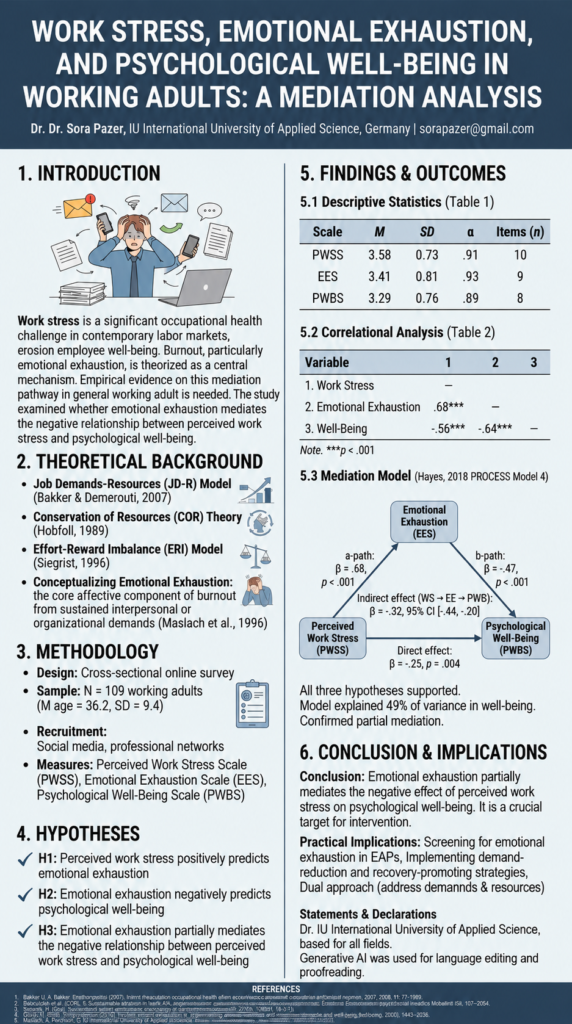
Background. Work stress is among the most consequential occupational health challenges in contemporary labour markets, with documented associations with reduced employee psychological well-being. Emotional exhaustion — the core affective component of burnout — has been theorised as a central mechanism linking chronic occupational demands to compromised psychological health, yet formal indirect-effect models examining this pathway in general working-adult samples remain comparatively sparse.
Aim. The present study examined whether emotional exhaustion statistically accounts for part of the association between perceived work stress and psychological well-being in a sample of working adults.
Design and Sample. A cross-sectional online survey was administered to N = 109 working adults (Mage = 36.3 years, SD = 9.3; 53.2% female; 84.4% full-time). Measures comprised the Perceived Work Stress Scale (PWSS; α = .94), the Emotional Exhaustion Scale (EES; α = .94), and the Psychological Well-Being Scale (PWBS; α = .92), all author-developed for this study.
Results. Perceived work stress was positively correlated with emotional exhaustion (r = .68, p < .001) and negatively correlated with psychological well-being (r = −.53, p < .001); emotional exhaustion was negatively correlated with well-being (r = −.55, p < .001). A bootstrapped indirect-effect analysis (PROCESS Model 4; Hayes, 2018; 5,000 resamples) yielded a significant indirect association of work stress with well-being through emotional exhaustion (β = −.23, 95% CI [−.39, −.10]), alongside a significant direct association (β = −.30, p = .006). The model accounted for 35% of the variance in psychological well-being.
Conclusion. Emotional exhaustion is associated with a substantial portion of the link between perceived work stress and reduced psychological well-being. Because the design is cross-sectional, the indirect effect is interpreted as consistent with — but not confirmatory of — the hypothesised causal pathway. The findings corroborate a well-established occupational-health mechanism and point to emotional exhaustion as a practically informative intervention target.
Scroll to read the preview. Download for the complete document.
Demerouti, E., Bakker, A. B., Nachreiner, F., & Schaufeli, W. B. (2001). The job demands-resources model of burnout. Journal of Applied Psychology, 86(3), 499–512. https://doi.org/10.1037/0021-9010.86.3.499
Diener, E. (1984). Subjective well-being. Psychological Bulletin, 95(3), 542–575. https://doi.org/10.1037/0033-2909.95.3.542
European Agency for Safety and Health at Work. (2022). Psychosocial risks and stress at work. https://osha.europa.eu/en/themes/psychosocial-risks-and-stress
Fornell, C., & Larcker, D. F. (1981). Evaluating structural equation models with unobservable variables and measurement error. Journal of Marketing Research, 18(1), 39–50. https://doi.org/10.2307/3151312
Hayes, A. F. (2018). Introduction to mediation, moderation, and conditional process analysis: A regression-based approach (2nd ed.). Guilford Press.
Henseler, J., Ringle, C. M., & Sarstedt, M. (2015). A new criterion for assessing discriminant validity in variance-based structural equation modeling. Journal of the Academy of Marketing Science, 43(1), 115–135. https://doi.org/10.1007/s11747-014-0403-8
Hobfoll, S. E. (1989). Conservation of resources: A new attempt at conceptualizing stress. American Psychologist, 44(3), 513–524. https://doi.org/10.1037/0003-066X.44.3.513
Hu, L., & Bentler, P. M. (1999). Cutoff criteria for fit indexes in covariance structure analysis: Conventional criteria versus new alternatives. Structural Equation Modeling, 6(1), 1–55. https://doi.org/10.1080/10705519909540118
Hülsheger, U. R., Alberts, H. J. E. M., Feinholdt, A., & Lang, J. W. B. (2013). Benefits of mindfulness at work: The role of mindfulness in emotion regulation, emotional exhaustion, and job satisfaction. Journal of Applied Psychology, 98(2), 310–325. https://doi.org/10.1037/a0031313
Johnson, J. V., & Hall, E. M. (1988). Job strain, work place social support, and cardiovascular disease: A cross-sectional study of a random sample of the Swedish working population. American Journal of Public Health, 78(10), 1336–1342. https://doi.org/10.2105/AJPH.78.10.1336
Karasek, R. A. (1979). Job demands, job decision latitude, and mental strain: Implications for job redesign. Administrative Science Quarterly, 24(2), 285–308. https://doi.org/10.2307/2392498
Karasek, R., & Theorell, T. (1990). Healthy work: Stress, productivity, and the reconstruction of working life. Basic Books.
Lazarus, R. S., & Folkman, S. (1984). Stress, appraisal, and coping. Springer.
Leka, S., & Jain, A. (2010). Health impact of psychosocial hazards at work: An overview. WHO Press.
Lindell, M. K., & Whitney, D. J. (2001). Accounting for common method variance in cross-sectional research designs. Journal of Applied Psychology, 86(1), 114–121. https://doi.org/10.1037/0021-9010.86.1.114
Llorens, S., Bakker, A. B., Schaufeli, W. B., & Salanova, M. (2006). Testing the robustness of the job demands-resources model. International Journal of Stress Management, 13(3), 378–391. https://doi.org/10.1037/1072-5245.13.3.378
Maslach, C., & Leiter, M. P. (2016). Understanding the burnout experience: Recent research and its implications for psychiatry. World Psychiatry, 15(2), 103–111. https://doi.org/10.1002/wps.20311
Maxwell, S. E., & Cole, D. A. (2007). Bias in cross-sectional analyses of longitudinal mediation. Psychological Methods, 12(1), 23–44. https://doi.org/10.1037/1082-989X.12.1.23
Podsakoff, P. M., MacKenzie, S. B., Lee, J.-Y., & Podsakoff, N. P. (2003). Common method biases in behavioral research: A critical review of the literature and recommended remedies. Journal of Applied Psychology, 88(5), 879–903. https://doi.org/10.1037/0021-9010.88.5.879
Rucker, D. D., Preacher, K. J., Tormala, Z. L., & Petty, R. E. (2011). Mediation analysis in social psychology: Current practices and new recommendations. Social and Personality Psychology Compass, 5(6), 359–371. https://doi.org/10.1111/j.1751-9004.2011.00355.x
Ryff, C. D. (1989). Happiness is everything, or is it? Explorations on the meaning of psychological well-being. Journal of Personality and Social Psychology, 57(6), 1069–1081. https://doi.org/10.1037/0022-3514.57.6.1069
Schaufeli, W. B., & Bakker, A. B. (2004). Job demands, job resources, and their relationship with burnout and engagement: A multi-sample study. Journal of Organizational Behavior, 25(3), 293–315. https://doi.org/10.1002/job.248
Schaufeli, W. B., Salanova, M., González-Romá, V., & Bakker, A. B. (2001). The measurement of engagement and burnout: A two-sample confirmatory factor analytic approach. Journal of Happiness Studies, 3(1), 71–92. https://doi.org/10.1023/A:1015630930326
Shirom, A. (2003). Job-related burnout: A review. In J. C. Quick & L. E. Tetrick (Eds.), Handbook of occupational health psychology (pp. 245–264). American Psychological Association.
Siegrist, J. (1996). Adverse health effects of high-effort/low-reward conditions. Journal of Occupational Health Psychology, 1(1), 27–41. https://doi.org/10.1037/1076-8998.1.1.27
Sonnentag, S., & Fritz, C. (2007). The Recovery Experience Questionnaire: Development and validation of a measure for assessing recuperation and unwinding from work. Journal of Occupational Health Psychology, 12(3), 204–221. https://doi.org/10.1037/1076-8998.12.3.204
World Health Organization. (2022). World mental health report: Transforming mental health for all. WHO Press.
Metrics are updated in real time as the article is accessed and downloaded.
Comments
Leave a Comment