
 Article
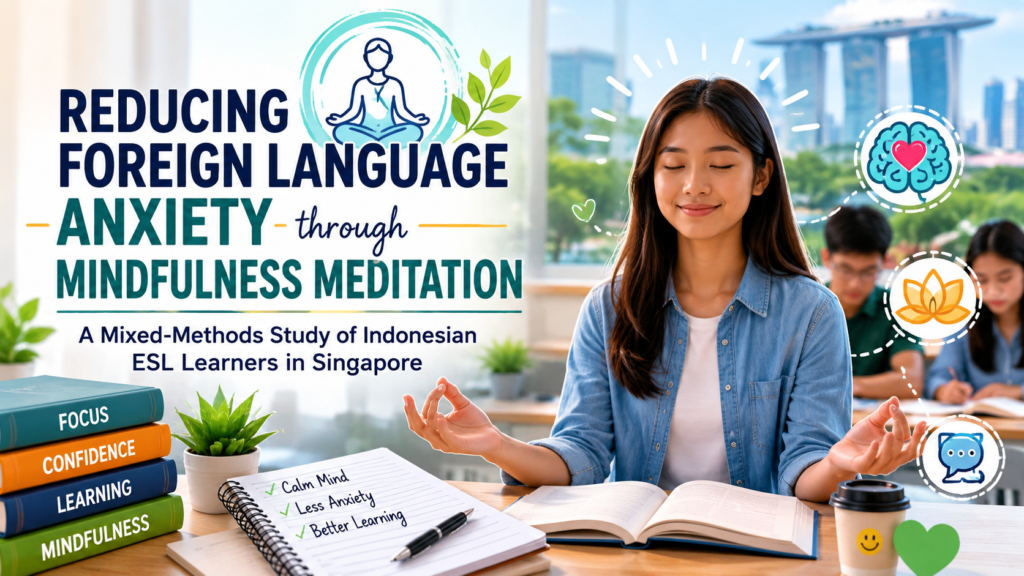
This exploratory single-group pilot study examined whether a brief mindfulness-meditation routine was associated with lower Foreign Language Anxiety (FLA) and improved language-learning experience among Indonesian ESL learners in Singapore. Through a mixed-methods action research design, the study conducted twelve face-to-face mindfulness sessions across four weeks with young learners who showed signs of language-related anxiety. The final analytic sample comprised 60 Indonesian-background learners aged seven to nine years, with complete pre- and post-intervention data and no recorded attrition. Within-group analysis showed a statistically significant reduction in FLA scores from pre-test to post-test (Mpre = 4.25, SD = 0.85; Mpost = 2.95, SD = 0.75; t(59) = 5.67, p < .001, Cohen’s dz = 0.73). Because the study did not include a comparison or waitlist control group, the results should be interpreted as preliminary within-group associations rather than as causal proof of intervention effectiveness. Self-reported language gains were strongest for speaking (25%), followed by writing (20%), listening (18%), and reading (15%), while a classroom-based performance indicator suggested improved willingness to attempt English tasks. Qualitative observations and learner feedback highlighted greater calmness, focus, engagement, and a more supportive classroom dynamic. The study suggests that age-appropriate mindfulness practices may be useful as a low-risk support within ESL instruction, while future controlled studies using stronger objective language measures are required.
Scroll to read the preview. Download for the complete document.
Asik, A. (2022). A Systematic Review of Mindfulness Studies in ESL and EFL Contexts. Journal on Educational Psychology, 15(3), 47-61. https://eric.ed.gov/?id=EJ1354544
Bashori, M., van Hout, R., Strik, H., & Cucchiarini, C. (2022). Web-based language learning and speaking anxiety. Computer Assisted Language Learning, 35(5-6), 1058-1089. https://doi.org/10.1080/09588221.2020.1770293
Bernardez, B., Durán, A., Parejo, J. A., Juristo, N., & Ruiz–Cortés, A. (2020). Effects of mindfulness on conceptual modeling performance: A series of experiments. IEEE Transactions on Software Engineering, 48(2), 432-452. https://doi.org/10.1109/TSE.2020.2991699
binti Mohamad, M. (2020). Investigating second language anxiety among polytechnic students. International Journal of Academic Research in Business and Social Sciences, 10(7), 632-637. https://www.semanticscholar.org/paper/Investigating-Second-Language-Anxiety-among-Mohamad/2db54d9010014390b9599fba07e05b31cf5dc13a?p2df
Breedvelt, J. J., Amanvermez, Y., Harrer, M., Karyotaki, E., Gilbody, S., Bockting, C. L., ... & Ebert, D. D. (2019). The effects of meditation, yoga, and mindfulness on depression, anxiety, and stress in tertiary education students: A meta-analysis. Frontiers in psychiatry, 10, 193. https://doi.org/10.3389/fpsyt.2019.00193
Brendel, W., & Cornett-Murtada, V. (2019). Professors practicing mindfulness: An action research study on transformed teaching, research, and service. Journal of Transformative Education, 17(1), 4-23. https://doi.org/10.1177/1541344618762535
Charoensukmongkol, P. (2019). The role of mindfulness in reducing English language anxiety among Thai college students. International journal of bilingual education and bilingualism, 22(4), 414-427. https://doi.org/10.1080/13670050.2016.1264359
Coleman, C. N., Coleman, K. F., Coleman, C. N., & Coleman, K. F. (2019). Learning the Essential Techniques of Mindfulness and Meditation Practice. Mindfulness for the High Performance World: A Practical, Skill-Based Approach to Developing and Sustaining Mindfulness, Equanimity and Balance, 51-69. https://doi.org/10.1007/978-3-030-18582-4_6
Fallah, N. (2017). Mindfulness, coping self-efficacy and foreign language anxiety: A mediation analysis. Educational Psychology, 37(6), 745-756.
Fattahi Marnani, P., & Cuocci, S. (2022). Foreign language anxiety: A review on theories, causes, consequences and implications for educators. Journal of English Learner Education, 14(2), 2. https://stars.library.ucf.edu/jele/vol14/iss2/2/
Frank, P., Fischer, D., Stanszus, L., Grossman, P., & Schrader, U. (2021). Mindfulness as self-confirmation? An exploratory intervention study on potentials and limitations of mindfulness-based interventions in the context of environmental and sustainability education. The Journal of Environmental Education, 52(6), 417-444. https://doi.org/10.1080/00958964.2021.1966352
Giraldi, T. (2019). Psychotherapy, mindfulness and Buddhist meditation. Springer Nature. https://doi.org/10.1007/978-3-030-29003-0
Guillaumie, L., Boiral, O., & Champagne, J. (2017). A mixed‐methods systematic review of the effects of mindfulness on nurses. Journal of advanced nursing, 73(5), 1017-1034. https://doi.org/10.1111/jan.13176
Hardacre, B., & Güvendir, E. (2020). Second language learning anxiety. The TESOL Encyclopedia of English Language Teaching, 1-7. https://www.researchgate.net/publication/344193947_Second_Language_Learning_Anxiety
Jin, Y., Dewaele, J. M., & MacIntyre, P. D. (2021). Reducing anxiety in the foreign language classroom: A positive psychology approach. System, 101, 102604. https://doi.org/10.1016/j.system.2021.102604
Lemay, V., Hoolahan, J., & Buchanan, A. (2019). Impact of a yoga and meditation intervention on students' stress and anxiety levels. American journal of pharmaceutical education, 83(5), 7001. https://doi.org/10.5688/ajpe7001
Li, C., Cai, Q. A., Elias, S., & Wilson-Jones, L. (2019). Mindfulness and well-being: A mixed methods study of bilingual guided meditation in higher education. Journal of Research Initiatives, 5(1), 3. https://digitalcommons.uncfsu.edu/jri/vol5/iss1/3/
Lopez-Maya, E., Olmstead, R., & Irwin, M. R. (2019). Mindfulness meditation and improvement in depressive symptoms among Spanish-and English speaking adults: A randomized, controlled, comparative efficacy trial. PLoS One, 14(7). https://doi.org/10.1371/journal.pone.0219425
Lymeus, F., Lindberg, P., & Hartig, T. (2019). A natural meditation setting improves compliance with mindfulness training. Journal of Environmental Psychology, 64, 98-106. https://doi.org/10.1016/j.jenvp.2019.05.008
Mantzios, M., & Egan, H. (2019). An experiential reflection of a mindful lecturer: exploring enhancement of active learning in higher education. Higher Education Pedagogies, 4(1), 304-306. https://doi.org/10.1080/23752696.2019.1629826
Morgan, W. J. (2019). Investigating the effects of mindfulness meditation on l2 learners’ self-efficacy in an instructed foreign language context. The University of Alabama. https://ir-api.ua.edu/api/core/bitstreams/2ba66bdf-7fdd-4815-8f28-75073dce7c0f/content
Morgan, W. J., & Katz, J. (2021). Mindfulness meditation and foreign language classroom anxiety: Findings from a randomized control trial. Foreign Language Annals, 54(2), 389-409. https://doi.org/10.1111/flan.12525
Nãdrag, L., & Buzarna-Tihenea, A. (2022). Teaching English through guided meditation. https://pdfs.semanticscholar.org/1871/7277ef50756aeac4814fe33931d6c2c5db4f.pdf
Park, M. H., Riley, J. G., & Branch, J. M. (2020). Developing self-awareness using mindfulness meditation with preservice teachers: Reflections on practice. Journal of Early Childhood Teacher Education, 41(2), 183-196. https://doi.org/10.1080/10901027.2019.1695692
Perwitasari, A. (2019). The acquisition of English vowels by Javanese and Sundanese native speakers. LOT, Netherlands Graduate School.
Ramasamy, S., Panneerselvam, S., Govindharaj, P., Kumar, A., & Nayak, R. (2018). Progressive muscle relaxation technique on anxiety and depression among persons affected by leprosy. Journal of exercise rehabilitation, 14(3), 375. https://www.ncbi.nlm.nih.gov/pmc/articles/PMC6028227/
Ran, C., Wang, Y., & Zhu, W. (2022). Comparison of foreign language anxiety based on four language skills in Chinese college students. BMC psychiatry, 22(1), 558. https://bmcpsychiatry.biomedcentral.com/articles/10.1186/s12888-022-04201-w
Russell, V. (2020). Language anxiety and the online learner. Foreign Language Annals, 53(2), 338-352. https://doi.org/10.1111/flan.12461
Saul, A. D., & Fish, M. T. (2019). Anxiety and college students: The benefits of mindfulness-based meditation. Recreation, Parks, and Tourism in Public Health, 3(1), 139-154. https://doi.org/10.2979/rptph.3.1.09
Shen, Y. (2022). Mitigating students’ anxiety: the role of resilience and mindfulness among Chinese EFL learners. Frontiers in Psychology, 13, 940443. https://doi.org/10.3389/fpsyg.2022.940443
Song, X., & He, X. (2021). Teachers’ Dispositions Toward Mindfulness in EFL/ESL Classrooms in Teacher-Student Interpersonal Relationships. Frontiers in Psychology, 12, 754998. https://doi.org/10.3389/fpsyg.2021.754998
Stratton, S. J. (2021). Population research: convenience sampling strategies. Prehospital and disaster Medicine, 36(4), 373-374. https://doi.org/10.1017/S1049023X21000649
Sun, Y., Lamoreau, R., O’Connell, S., Horlick, R., & Bazzano, A. N. (2021). Yoga and mindfulness interventions for preschool-aged children in educational settings: A systematic review. International Journal of Environmental Research and Public Health, 18(11), 6091. https://www.ncbi.nlm.nih.gov/pmc/articles/PMC8201280/
Toyama, M., & Yamazaki, Y. (2021). Anxiety reduction sessions in foreign language classrooms. The Language Learning Journal, 49(3), 330-342. https://doi.org/10.1080/09571736.2019.1598474
Wang, N. (2022). EFL teachers’ mindfulness and emotion regulation in language context. Frontiers in Psychology, 13. https://doi.org/10.3389/fpsyg.2022.877108
Wang, X., & Zhang, W. (2021). Psychological anxiety of college Students' foreign language learning in online course. Frontiers in psychology, 12. https://doi.org/10.3389/fpsyg.2021.598992
Wang, Y., & Liu, C. (2016). Cultivate mindfulness: A case study of mindful learning in an English as a foreign language classroom. IAFOR journal of education, 4(2), 141-155. https://files.eric.ed.gov/fulltext/EJ1142103.pdf
Wielgosz, J., Goldberg, S. B., Kral, T. R., Dunne, J. D., & Davidson, R. J. (2019). Mindfulness meditation and psychopathology. Annual review of clinical psychology, 15, 285-316. https://www.annualreviews.org/doi/abs/10.1146/annurev-clinpsy-021815-093423
Yan, J. X., & Liang, J. (2022). Foreign language anxiety and dependency distance in English–Chinese interpretation classrooms. Frontiers in Psychology, 13, 952664. https://www.frontiersin.org/articles/10.3389/fpsyg.2022.952664/full#B48
Zeilhofer, L. (2023). Mindfulness in the foreign language classroom: Influence on academic achievement and awareness. Language Teaching Research, 27(1), 96-114. https://doi.org/10.1177/1362168820934624
Zheng, Y. (2008). Anxiety and second/foreign language learning revisited. Canadian Journal for New Scholars in Education/Revue canadienne des jeunes chercheures et chercheurs en education, 1(1). https://files.eric.ed.gov/fulltext/ED506736.pdf
Zhu, D. (2022). English as a Foreign Language Teachers’ Identity and Motivation: The Role of Mindfulness. Frontiers in Psychology, 13, 940372. https://doi.org/10.3389/fpsyg.2022.940372
British Educational Research Association. (2018). Ethical guidelines for educational research (4th ed.). British Educational Research Association.
Cohen, J. (1988). Statistical power analysis for the behavioral sciences (2nd ed.). Lawrence Erlbaum Associates.
Horwitz, E. K., Horwitz, M. B., & Cope, J. (1986). Foreign language classroom anxiety. The Modern Language Journal, 70(2), 125-132.

Metrics are updated in real time as the article is accessed and downloaded.
Comments
1Leave a Comment
Interested approach and informative