
 Article
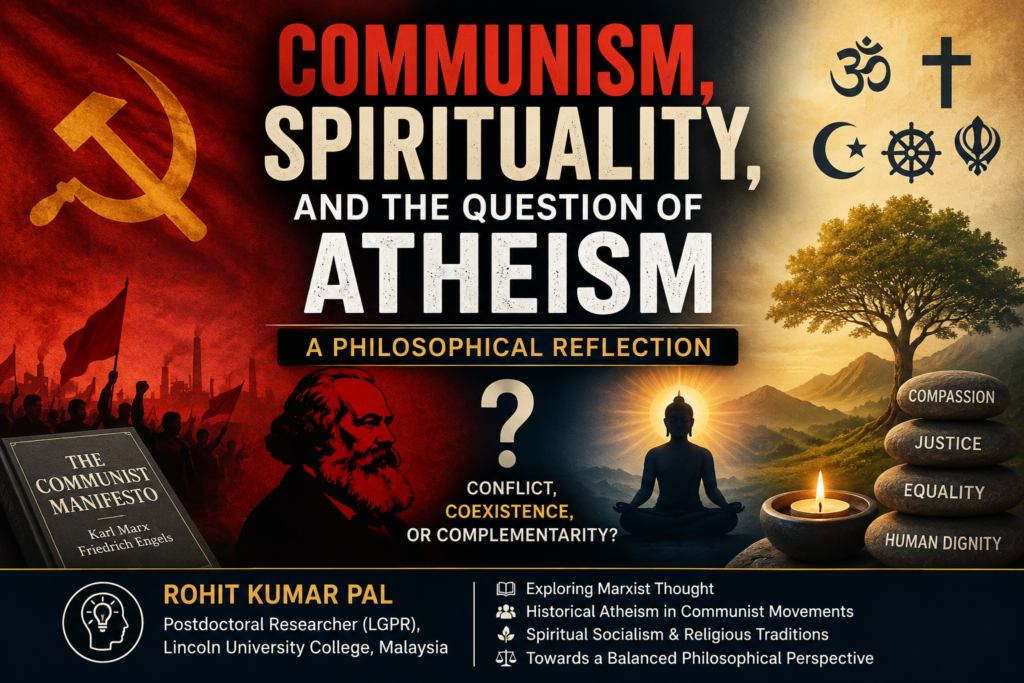
Communism and spirituality are often presented as opposing forces in modern political and philosophical debates. Many people associate communism with atheism because several communist governments and leaders historically promoted secularism and rejected organized religion. However, communism as an economic and political theory does not necessarily require atheism. Spirituality concerns the inner life, morality, meaning, compassion, and the relationship between humanity and the transcendent, while communism primarily addresses social equality, collective ownership, and economic justice. This monograph examines the relationship between communism and spirituality by analyzing Marxist thought, the historical development of atheist communist movements, and examples of spiritual or religious socialism across the world. It argues that atheism emerged more from political interpretations of communism than from the unavoidable essence of communist philosophy itself. The study further explores how some communist thinkers treated humanity as the highest value, leading critics to claim that “people became their god.” Ultimately, spirituality and communism represent different pathways that may conflict in some contexts yet coexist in others.
Scroll to read the preview. Download for the complete document.
Brentlinger, J. (2000). Revolutionizing spirituality: Reflections on Marxism and religion. Science & Society, 64(2), 251–267.
Buchenau, K. (2015). Socialist secularities: The diversity of a universalist model. In Religion and modernity in the Balkans (pp. 261–280). Palgrave Macmillan.
Elmore, J. M. (2016). Religion, authoritarianism and the perpetuation of capitalism: The role of atheism in a Marxist critical pedagogy. Critical Education, 7(16), 1–18.
Engineer, A. A. (1989). Religion and liberation. Sterling Publishers.
Geoghegan, V. (2004). Religion and communism: Feuerbach, Marx and Bloch. The European Legacy, 9(1), 37–49.
Marx, K. (2001). Marxism, socialism and religion. Resistance Books.
Pal, R. K. The Decline of Political Ideology in Contemporary Democracy: Electoral Opportunism and the Crisis of Public Trust.
Pospielovsky, D. V. (1987). A history of Marxist-Leninist atheism and Soviet antireligious policies. St. Martin’s Press.
Rehmann, J., & Kahl, B. (2013). A spirituality of the commons: Where religion and Marxism meet. Tikkun, 28(1), 45–50.
Rothbard, M. N. (1990). Karl Marx: Communist as religious eschatologist. Review of Austrian Economics, 4(1), 123–179.
Shields, J. M. (2022). Buddhist socialism in China, 1900–1930: A history and appraisal. In Marxism, religion, and emancipatory politics (pp. 101–126). Springer.
Smolkin-Rothrock, V. (2010). A sacred space is never empty: Soviet atheism, 1954–1971 (Doctoral dissertation, University of California).
Stromberg, R. N. (1979). Marxism and religion. Studies in Soviet Thought, 19(3), 209–221.
Thrower, J. A. (1980). Marxist-Leninist scientific atheism and the study of religion and atheism in the USSR today. Mouton Publishers.
Waistell, J. (2014). A Buddhist-Communist manifesto. Buddhism for Sustainable Society.
Metrics are updated in real time as the article is accessed and downloaded.
Comments
Leave a Comment