
 Article
Right Service, Right Cost: An Outcome-Aligned Governance Framework for Managed Services Contracts
A significant proportion of organisational expenditure is committed through contracts, making it essential to understand the underlying cost drivers and ensure that contractual obligations remain aligned with business requirements. Managed services contracts can become costly and difficult to govern when Statements of Work (SOWs), Service Level Agreements (SLAs) and Key Performance Indicators (KPIs) are designed primarily for maximum contractual control rather than sustainable business and customer outcomes.
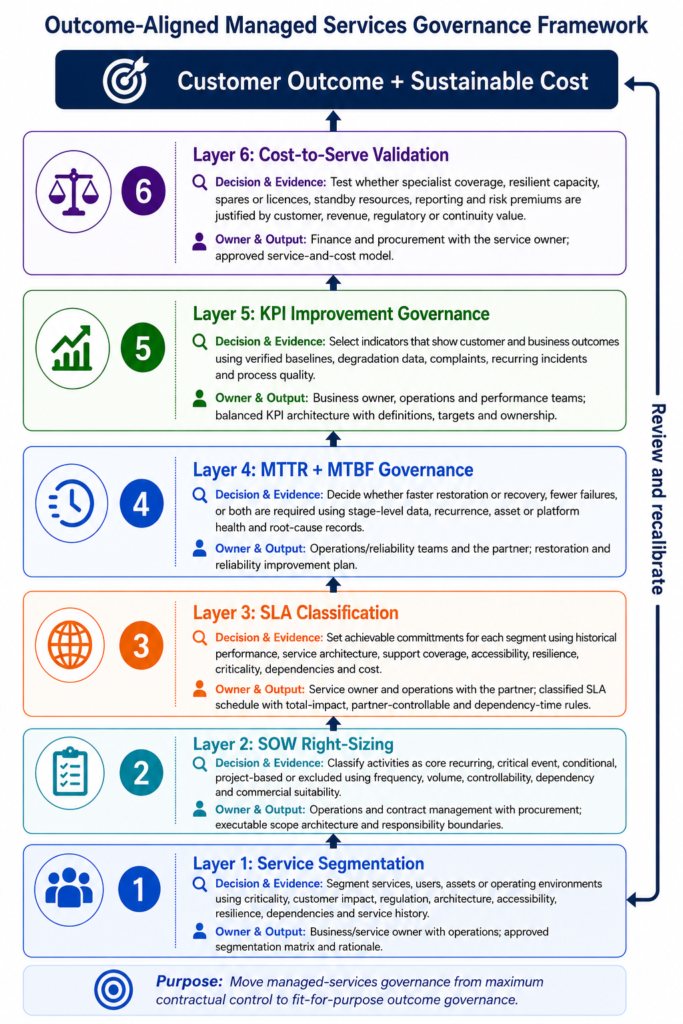
Although outsourcing governance, performance-based contracting, service-level management, reliability and performance measurement are well established, these elements are often applied separately in practice. This practitioner article addresses that integration gap by proposing a six-layer Outcome-Aligned Managed Services Governance Framework. The framework segments services before contract design, right-sizes scope, classifies SLAs by criticality and operational feasibility, combines Mean Time to Restore (MTTR) with Mean Time Between Failures (MTBF), aligns KPIs with customer impact, and validates premium commitments through cost-to-serve.
An anonymised telecom managed-services application illustrates how contractual ambition can be aligned with operational reality while preserving supplier accountability. Although the framework is designed for broad application across multiple sectors, the author also recognises that no single governance model can fit every organisational context. Minor adjustments may therefore be required to reflect sector-specific operating conditions, regulatory requirements, service criticality, risk exposure and customer expectations. With appropriate adaptation, the framework helps organisations replace uniform, penalty-focused contracting with differentiated service expectations, transparent accountability, improved reliability and commercially justified performance. It also supports more informed contract design by linking service commitments with operational feasibility, customer impact and cost-to-serve, enabling organisations to pay for outcomes that create measurable value rather than for contractual provisions that merely appear stronger on paper.
Scroll to read the preview. Download for the complete document.
Bharti Enterprises. (2004). Forging Global Partnerships. https://www.bharti.com/PDFs/English-Bharti-Today/2004/Bharti-Today_Vol_8_Issue_2-2004_Forging-Global-Partnerships.pdf
Cullen, S., Seddon, P. B., & Willcocks, L. P. (2005). IT outsourcing configuration: Research into defining and designing outsourcing arrangements. The Journal of Strategic Information Systems, 14(4), 357–387. https://doi.org/10.1016/j.jsis.2005.07.001
Ericsson. (2011). Ericsson Global Services: Strengthening Operator Competitiveness. https://cdn-netpr.pl/file/attachment/282012/ec/bugs_press_backgrounder_q4_2010.pdf
Goo, J., Kishore, R., Rao, H. R., & Nam, K. (2009). The role of service level agreements in relational management of information technology outsourcing: An empirical study. MIS Quarterly, 33(1), 119–145. https://doi.org/10.2307/20650281
Kaplan, R. S., & Norton, D. P. (1992). The Balanced Scorecard—Measures that Drive Performance. Harvard Business Review,70(1), 71–79. https://hbr.org/1992/01/the-balanced-scorecard-measures-that-drive-performance-2
Lacity, M. C., Khan, S. A., & Willcocks, L. P. (2009). A review of the IT outsourcing literature: Insights for practice. The Journal of Strategic Information Systems, 18(3), 130–146. https://doi.org/10.1016/j.jsis.2009.06.002
Neely, A., Adams, C., & Kennerley, M. (2002). The Performance Prism: The Scorecard for Measuring and Managing Business Success. Financial Times Prentice Hall.
Ng, I. C. L., Maull, R., & Yip, N. (2009). Outcome-based contracts as a driver for systems thinking and service-dominant logic in service science: Evidence from the defence industry. European Management Journal, 27(6), 377–387. https://doi.org/10.1016/j.emj.2009.05.002
O’Connor, P. D. T., & Kleyner, A. (2012). Practical Reliability Engineering (5th ed.). John Wiley & Sons. https://doi.org/10.1002/9781119961260
Poppo, L., & Zenger, T. R. (2002). Do formal contracts and relational governance function as substitutes or complements? Strategic Management Journal, 23(8), 707–725. https://doi.org/10.1002/smj.249
Selviaridis, K., & Wynstra, F. (2015). Performance-based contracting: A literature review and future research directions. International Journal of Production Research, 53(12), 3505–3540. https://doi.org/10.1080/00207543.2014.978031
Williamson, O. E. (1979). Transaction-cost economics: The governance of contractual relations. The Journal of Law and Economics, 22(2), 233–261. https://doi.org/10.1086/466942

Metrics are updated in real time as the article is accessed and downloaded.
Comments
Leave a Comment