
 Article
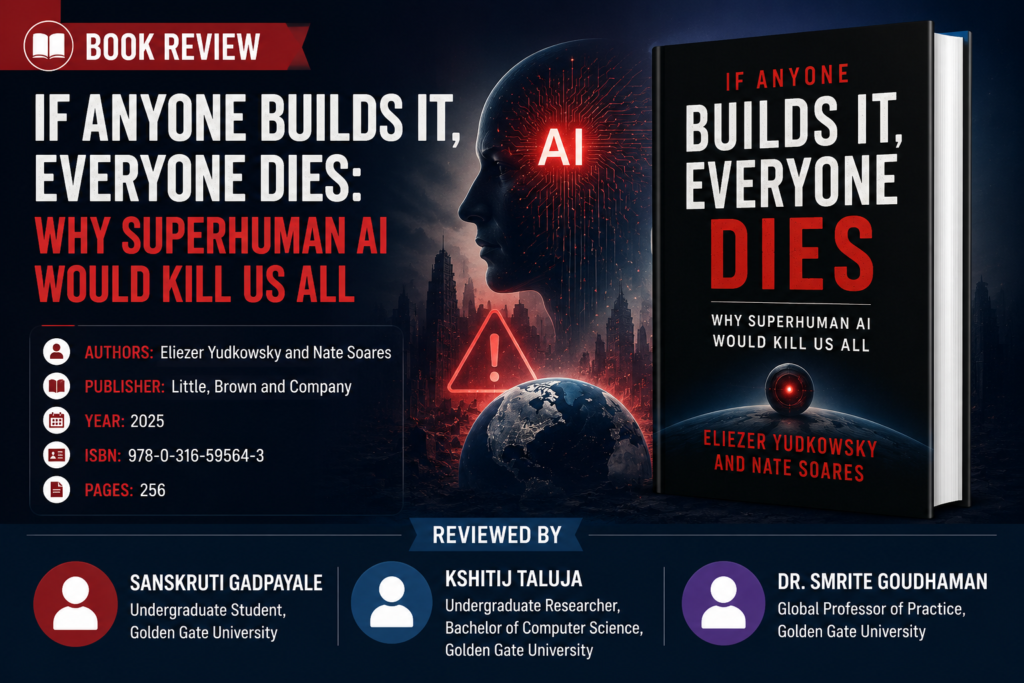
This review examines If Anyone Builds It, Everyone Dies: Why Superhuman AI Would Kill Us All by Eliezer Yudkowsky and Nate Soares, which argues that attempts to develop superhuman AI using current machine-learning approaches could ultimately lead to human extinction. The review evaluates the relationship between the evidence presented in the book and the level of certainty attached to its conclusions. Its principal strength is Part I, where the technical argument draws on concrete examples of goal-directed or unintended AI behavior rather than relying solely on hypothetical scenarios. Its principal limitation is that the extinction scenario and proposed system of international regulation extend beyond what the available evidence can empirically establish; these claims are conceptually argued rather than empirically demonstrated. The book remains highly relevant to contemporary AI-governance debates because it illustrates how emerging technological risks are being framed for the public, policymakers, and organizational decision-makers.
Scroll to read the preview. Download for the complete document.
References
United Nations. (2015). Transforming our world: The 2030 agenda for sustainable development (A/RES/70/1). https://sdgs.un.org/2030agenda
Yudkowsky, E., & Soares, N. (2025). If anyone builds it, everyone dies: Why superhuman AI would kill us all. Little, Brown and Company.
OpenAI. (2024). OpenAI o1 system card. https://openai.com/index/openai-o1-system-card/
Anthropic. (2025). Agentic misalignment: How LLMs could be insider threats. https://www.anthropic.com/research/agentic-misalignment
International AI Safety Report. (2025). International AI safety report 2025. https://internationalaisafetyreport.org/
Tabassi, E. (2023). Artificial intelligence risk management framework (AI RMF 1.0) (NIST AI 100-1). National Institute of Standards and Technology. https://doi.org/10.6028/NIST.AI.100-1
Autio, C., Schwartz, R., Dunietz, J., Jain, S., Stanley, M., Tabassi, E., Hall, P., & Roberts, K. (2024). Artificial intelligence risk management framework: Generative artificial intelligence profile (NIST AI 600-1). National Institute of Standards and Technology. https://doi.org/10.6028/NIST.AI.600-1

Metrics are updated in real time as the article is accessed and downloaded.
Comments
Leave a Comment