
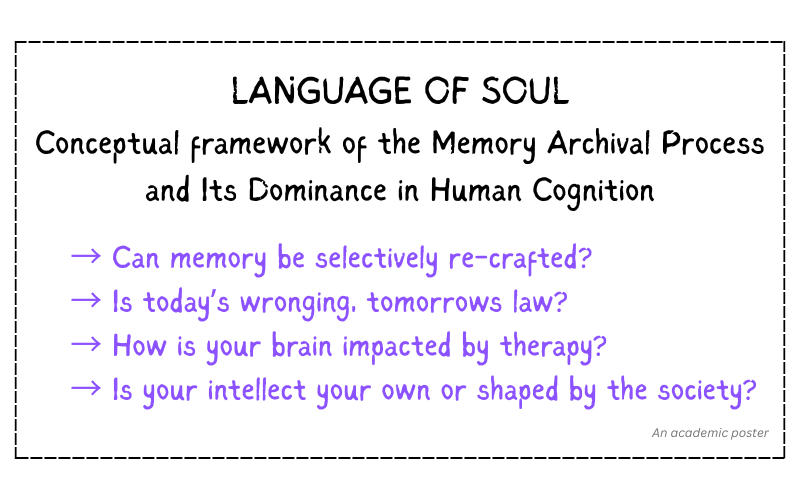
 Poster
The human brain is one of the most complex structures, consisting of specialized parts functioning synchronously. In philosophy, the term ‘soul’ is used to describe the force driving living beings, similar to a charioteer driving a chariot. However, modern neuroscience rejects the idea of a soul and explains human activity and brain phenomena in terms of neural mechanisms. The 21st century has witnessed a rise in research in the domain of cognitive behavioral intervention; neural disorders have become a rising concern in the modern world, leading to a need for consistent development in cognitive behavioral intervention and medications. Distressing events often lead to traumatic behavior, depression, anxiety, and so forth; thus, it is crucial to understand the influence of memories in individualistic development. Unlike modern computers, which allow deletion of folders, it is not feasible to locate the traumatic memory and erase it from the memory module, but then, how does therapy make a significant impact at the neural level? Human cognition remains a complex hurdle in scientific research, with numerous higher-order cognitive processes demanding more comprehensive modeling and empirical study. In this paper, a conceptual framework is introduced to elucidate the process of memory archival in humans, further investigating the dominance of memories in human cognition .
Scroll to read the preview. Download for the complete document.
Lewin, K. (1936). Principles of topological psychology. McGraw-Hill.
Vygotsky, L. S. (1978). Mind in society: The development of higher psychological processes (M. Cole, V. John-Steiner, S. Scribner, & E. Souberman, Eds.). Harvard University Press.
Hebb, D. O. (1949). The organization of behavior: A neuropsychological theory. Wiley.
Fodor, J. A. (1983). The modularity of mind: An essay on faculty psychology. MIT Press.
Binz, M., Akata, E., Bethge, M., Brändle, F., Callaway, F., Coda-Forno, J., ... Schulz, E. (2025). A foundation model to predict and capture human cognition. Nature, 644(8078), 892–902. https://www.nature.com/articles/s41586-025-09215-4
Addis, D. R. (2015, March 15). Linking the past to the future through memory. Cognitive Neuroscience Society. https://www.cogneurosociety.org/memory_addis_yia/
Brainerd, C. J., & Reyna, V. F. (1990). Gist is the grist: Fuzzy-trace theory and the new intuitionism. Developmental Review, 10(1), 3–47. https://www.sciencedirect.com/science/article/abs/pii/1041608095900314
Sheldon, S. (2025, October 20). Storytelling methods alter how memories are stored in the brain. Scientific American. https://www.scientificamerican.com/article/storytelling-methods-alter-how-memories-are-stored-in-the-brain/
Ebbinghaus, H. (1913). Memory: A contribution to experimental psychology (H. A. Ruger & C. E. Bussenius, Trans.). Teachers College, Columbia University. (Original work published 1885)
Miller, G. A. (1956). The magical number seven, plus or minus two: Some limits on our capacity for processing information. Psychological Review, 63(2), 81–97. https://labs.la.utexas.edu/gilden/files/2016/04/MagicNumberSeven-Miller1956.pdf
Tulving, E. (1972). Episodic and semantic memory. In E. Tulving & W. Donaldson (Eds.), The structure of human memory (pp. 381–403). W. H. Freeman.
Neisser, U., & Harsch, N. (1992). Phantom flashbulbs: False recollections of hearing the news about Challenger. In E. Winograd & U. Neisser (Eds.), Affect and accuracy in recall: Studies of "flashbulb" memories (pp. 9–28). Cambridge University Press.
Sharot, T., Marti, S., Dolcos, F., Mackey, C. E., Kanwisher, N. G., & Phelps, E. A. (2007). How personal experience modulates the neural circuitry of memories of September 11. Proceedings of the National Academy of Sciences, 104(1), 389-393. https://pmc.ncbi.nlm.nih.gov/articles/PMC1713166/
Loh, K. K., & Kanai, R. (2016). How has the Internet reshaped human cognition? The Neuroscientist, 22(5), 506–520. https://journals.sagepub.com/doi/10.1177/1073858415595005
Beck, A. T. (1976). Cognitive therapy and the emotional disorders. International Universities Press.
Stinnett, T. J., & Jatoi, N. A. (2023). Neuroanatomy, Broca's area. In StatPearls. StatPearls Publishing. https://www.ncbi.nlm.nih.gov/books/NBK526096/
Javed, K., & M Das, J. (2023). Neuroanatomy, Wernicke area. In StatPearls. StatPearls Publishing. https://www.ncbi.nlm.nih.gov/books/NBK533001/
Cleveland Clinic. (2024). Hippocampus. https://my.clevelandclinic.org/health/body/hippocampus
Friederici, A. D. (2011). The brain basis of language processing: From structure to function. Physiological Reviews, 91(4), 1357–1392. https://journals.physiology.org/doi/full/10.1152/physrev.00006.2011
LeDoux, J. E. (2000). The emotional brain: The mysterious underpinnings of emotional life. Simon & Schuster.
Freud, S. (2010). The interpretation of dreams (J. Strachey, Trans.). Basic Books. (Original work published 1900)
Piaget, J. (1952). The origins of intelligence in children. International Universities Press.
Ribot, T. (1882). Diseases of memory: An essay in the positive psychology. D. Appleton and Company. https://archive.org/details/diseasesofmemory00ribo
Simons, D. J., & Chabris, C. F. (1999). Gorillas in our midst: Sustained inattentional blindness for dynamic events. Perception, 28(9), 1059–1074.
Karmiloff-Smith, A., Casey, B. J., & Thomas, M. S. C. (2023). Neuroconstructivism at 20: Promises and challenges. Developmental Cognitive Neuroscience, 62, 101267.
Westermann, G., Mareschal, D., Johnson, M. H., Sirois, S., Spratling, M. W., & Thomas, M. S. C. (2007). Neuroconstructivism. Developmental Science, 10(1), 75–83. https://onlinelibrary.wiley.com/doi/10.1111/j.1467-7687.2007.00567.x
Nader, K., & Hardt, O. (2009). A single standard for memory: the case for reconsolidation. Nature Reviews Neuroscience, 10(3), 224-234.
Schiller, D., Monfils, M. H., Raio, C. M., Johnson, D. C., LeDoux, J. E., & Phelps, E. A. (2010). Preventing the return of fear in humans using reconsolidation update mechanisms. Nature, 463(7277), 49-53.
Baumeister, R. F., Bratslavsky, E., Finkenauer, C., & Vohs, K. D. (2001). Bad is stronger than good. Review of general psychology, 5(4), 323-370.
Kahneman, D., & Tversky, A. (1982). On the study of statistical intuitions. Cognition, 11(2), 123-141.

Metrics are updated in real time as the article is accessed and downloaded.
Comments
Leave a Comment