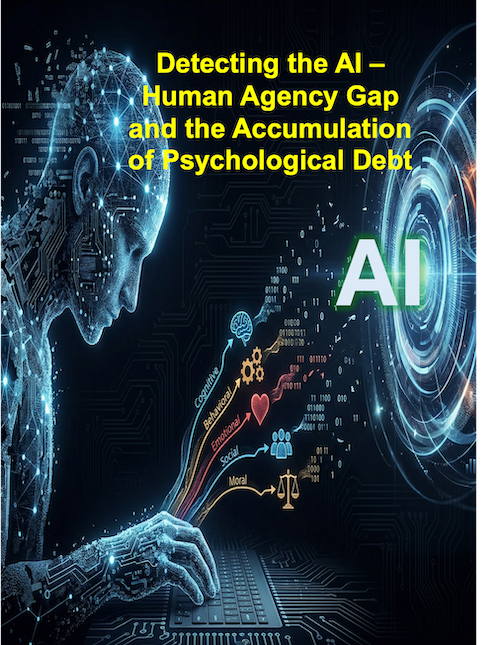
As Generative AI becomes ubiquitous in professional and personal workflows, a critical ‘AI – Human Agency Gap’ is emerging. This in-progress research investigates the systemic depletion of human capabilities across five psychological domains: Cognitive, Emotional, Behavioural, Social, and Moral. The study posits that the continuous offloading of tasks to AI leads to the accumulation of ‘Psychological Debt’ — a structural deficit in human agency triggered by what the author defines as the transactional ‘You-do-it’ Syndrome. Utilizing a mixed-methods exploratory sequential design, this work aims to develop and validate a first of its kind standardized diagnostic: the AI-Induced Psychological Debt Accumulation (AI-PDA) Scale. By operationalizing the ‘interest rate’ of AI offloading as a measurable variable of capability erosion, the AI-PDA scale moves beyond superficial efficiency metrics to provide a predictive tool for safeguarding human sovereignty in an increasingly automated landscape.
References Abrams, Z. (2025, Jan). Artificial intelligence is impacting the field. APA, Vol. 56, No. 1. https://www.apa.org/monitor/2025/01/trends-harnessing-power-of-artificial-intelligenceAli, Z. et al. (2024, Sep). Understanding Digital Dementia and Cognitive Impact in the Current Era of the Internet: A Review. Cureus, 16(9), e70029. https://doi.org/10.7759/cureus.70029Annett, E. & Giordano J. (2025, Dec). Human Agency Under Predictive Insight: Neuroethical Guidance of Behavioral AI. Institute for National Strategic Studies National Defense University (INSS). https://inss.ndu.edu/Research-and-Commentary/View-Publications/Article/4345754/human-agency-under-predictive-insight-neuroethical-guidance-of-behavioral-ai/Bandura, A. (1991). Social Cognitive theory of Self- Regulation. Organizational Behavior and Human Decision Processes, 50, 248-287. https://doi.org/10.1016/0749-5978(91)90022-LBandura, A. (1999). Moral Disengagement in the Perpetration of Inhumanities. Personality and Social Psychology Review, 3 (3), 193-209. https://doi.org/10.1207/s15327957pspr0303_3Buenadicha-Mateos, M. (2022). Analysis of the Emotional Exhaustion Derived From Techno-Stress in the Next Generation of Qualified Employees. Frontier Psychology, Sec. Organizational Psychology Volume 13, 2022. https://doi.org/10.3389/fpsyg.2022.792606Caplan, S. E. (2010). Theory and measurement of generalized problematic Internet use: A two-step approach. ScienceDirect. https://doi.org/10.1016/j.chb.2010.03.012Corkum, M. & Shead, N. W. (2025). Online Moral Disengagement: An Examination of the Relationships Between Electronic Communication, Cognitive Empathy, and Antisocial Behavior on the Internet. Psychological reports, 128(6), 4169–4192.https://doi.org/10.1177/00332941231216415Davidson, R. (2024). Digital Media Driving Mental Health Disorders in Young Adults. US Pharmacist, U.S. Pharm. 2024;49(5):4. https://www.uspharmacist.com/article/digital-media-driving-mental-health-disorders-in-young adults#:~:text=The%20rate%20of%20individuals%20reporting,47%25%20from%202008%20to%202017Deci, E. L., & Ryan, R. M. (1985). Intrinsic motivation and self-determination in human behaviour. Plenum Press. https://doi.org/10.1007/978-1-4899-2271-7DeVellis, R. F. & Thorpe, C. T. (2022). Scale Development (5th Edition). SAGE Publications.Fan, Y. et al. (2024). Beware of metacognitive laziness: Effects of generative artificial intelligence on learning motivation, processes, and performance. British Journal of Educational Technology.https://bera-journals.onlinelibrary.wiley.com/doi/10.1111/bjet.13544Gerlich M. AI Tools in Society: Impacts on Cognitive Offloading and the Future of Critical Thinking. Societies. 2025; 15(1):6. https://doi.org/10.3390/soc15010006Ghotbi, N., & Ho, M. T. (2021). Moral Awareness of College Students Regarding Artificial Intelligence. Asian bioethics review, 13(4), 421–433. https://doi.org/10.1007/s41649-021-00182-2GOH, Adalia Yin Hui. (2025). Generative Artificial Intelligence dependency: Scale development, validation, and its motivational, behavioural, and psychological correlates. (2025). Ink, Singapore Management University (SMU), 1-87. https://ink.library.smu.edu.sg/etd_coll/774Gross, J. J. (1998). The emerging field of emotion regulation: An integrative review. Review of General Psychology, 2(3), 271–299. https://doi.org/10.1037/1089-2680.2.3.271Kosmyna, N. et al. (2025). Your Brain on ChatGPT: Accumulation of Cognitive Debt when Using an AI Assistant for Essay Writing Task. ARXIV, Cornell University. https://arxiv.org/abs/2506.08872Mushtaq, N.F. (2025). Bridging the Gap: The Role of AI Chatbots in Reducing Loneliness and Improving Emotional Regulation. International Journal of Indian Psychology, 13(1), 2302-2307. https://ijip.in/wp-content/uploads/2025/04/18.01.218.20251301.pdfsOngun, P. et al. (2025, Aug). Artificial Intelligence Anxiety and Patient Safety Attitudes Among Operating Room Professionals: A Descriptive Cross-Sectional Study. PubMed Central, National Library of Medicine, Healthcare, 13(16), 2021 https://doi.org/10.3390/healthcare13162021Paoli, C. (2025). Study: Generative AI Could Inhibit Critical Thinking. Campus Technology.https://campustechnology.com/articles/2025/02/21/study-generative-ai-could-inhibit-critical-thinking.aspx?admgarea=ai-portal#:~:text=,skill%20for%20independent%20problem%20solvingPrice-Mitchell, M. (2020). Are Young People's Social Skills Declining? Psychology Today.https://www.psychologytoday.com/ca/blog/the-moment-of-youth/202004/are-young-peoples-social-skills-declining#:~:text=From%201998%20to%202010%2C%20teacher,in%202010%20than%20in%201998Primack, B. A. (2017). Social Media Use and Perceived Social Isolation Among Young Adults in the U.S. American journal of preventive medicine, 53(1), 1–8. https://doi.org/10.1016/j.amepre.2017.01.010Ratan, Z. A., et al. (2021). Smartphone Addiction and Associated Health Outcomes in Adult Populations: A Systematic Review. International Journal of Environmental Research and Public Health, 18(22), 12257. https://doi.org/10.3390/ijerph182212257Reif, J. A., Larrick, R. P., & Soll, J. B. (2025). Evidence of a social evaluation penalty for using AI. Proceedings of the National Academy of Sciences of the United States of America, 122(19), e2426766122. https://doi.org/10.1073/pnas.2426766122Rokhsari, S. (2025). The Impact of Artificial Intelligence on Learners’ Memory: A Systematic Review. Journal of Cognition, Emotion & Education, 3(2), 18-34. DOI: 10.22034/cee.2025.542883.1040Romeo, G. & Conti, D. (2026). Exploring automation bias in human–AI collaboration: a review and implications for explainable AI. AI & Soc 41, 259–278 (2026). https://doi.org/10.1007/s00146-025-02422-7Risko, E & Gilbert, S. (2016). Cognitive Offloading. Volume 20, Issue 9 P676-688 September 2016. DOI: 10.1016/j.tics.2016.07.002Santoni de Sio, F., Mecacci, G. Four Responsibility Gaps with Artificial Intelligence: Why they Matter and How to Address them. Philos. Technol. 34, 1057–1084 (2021). https://doi.org/10.1007/s13347-021-00450-xSiddals, S., Torous, J. & Coxon, A. “It happened to be the perfect thing”: experiences of generative AI chatbots for mental health. npj Mental Health Res 3, 48 (2024). https://doi.org/10.1038/s44184-024-00097-4Sparrow, B. et al. (2011). Google Effects on Memory: Cognitive Consequences of Having Information at Our Fingertips. Science Mag, 333, 776. https://www.science.org/doi/10.1126/science.1207745Sweller, J. (1988, Apr). Cognitive Load During Problem Solving: Effects on Learning. Cognitive Science – A Multidisciplinary Journal. https://doi.org/10.1207/s15516709cog1202_4Short, J., Williams, E., & Christie, B. (1976). The social psychology of telecommunications. London: John Wiley & Sons.Wang, Y., Zeng, Y. Relationship between loneliness and internet addiction: a meta-analysis. BMC Public Health 24, 858 (2024).https://doi.org/10.1186/s12889-024-18366-4Watts, K. J. (2025). Paying the Cognitive Debt: An Experiential Learning Framework for Integrating AI in S Social Work Education. EducationSciences, 15(10), 1304. https://doi.org/10.3390/educsci15101304Wu, J. (2024). Social and ethical impact of emotional AI advancement: the rise of pseudo-intimacy relationships and challenges in human interactions. Front. Psychol. 15:1410462. https://doi.org/10.3389/fpsyg.2024.1410462Zhang, H., Liu, Y., Jiang, M. et al. Emotional Artificial Intelligence in Education: A Systematic Review and Meta-Analysis. Educ Psychol Rev 37, 106 (2025). https://doi.org/10.1007/s10648-025-10086-4Zhang, Y., Wu, J., Yu, F., & Xu, L. (2023). Moral Judgments of Human vs. AI Agents in Moral Dilemmas. Behavioral sciences (Basel, Switzerland), 13(2), 181. https://doi.org/10.3390/bs13020181

 Article