
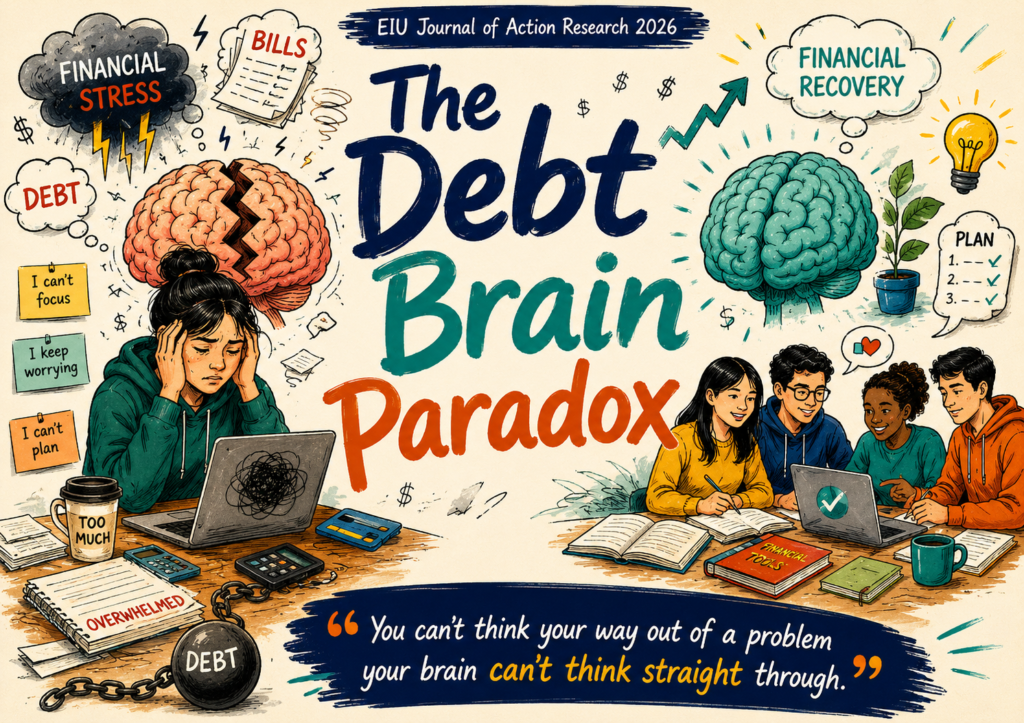
 Poster
Background: Financial stress is typically framed as a behavioral or educational deficit — the assumption being that people in debt simply lack financial knowledge. Emerging neurofinance research challenges this, suggesting chronic financial stress directly impairs the cognitive architecture required for sound financial decision-making, creating a self-perpetuating cycle: the "Debt Brain Paradox."
Aim: This action research study investigated whether a psychoeducational intervention targeting the neurological — rather than purely informational — mechanisms of financial stress could improve financial decision-making and reduce anxiety among postgraduate students.
Method: Fifteen international postgraduate students (10 nationalities) with moderate-to-severe Financial Anxiety Scale scores (FAS ≥10) participated in a six-session Neurofinancial Literacy Intervention (NLI) grounded in Social Penetration Theory, neurofinance research, and cognitive behavioral therapy. Sessions progressed from neuroscience psychoeducation through cognitive reframing, working memory/bias training, financial engineering tools, and personal decision protocols, to a 12-month integration plan.
Results: Pre-post comparisons showed statistically significant improvements (all p < .01) across all measures: executive function (53.8 → 62.4/100, d = 0.99), financial anxiety (FAS 14.9 → 11.2/21, d = 1.18), financial decision quality (46.7% → 61.3%, d = 1.31), and working memory accuracy (63.1% → 69.8%, d = 0.84).
Conclusion: Addressing the neurological impairments of financial stress before delivering financial literacy content produces large, statistically significant improvements in decision-making capacity. Universities should reframe financial wellness programming as a neurocognitive recovery intervention, not solely an information-transfer exercise.
Keywords: financial stress; neurofinance; cognitive load; executive function; financial anxiety; action research; higher education; prefrontal cortex; cortisol; student wellbeing
Scroll to read the preview. Download for the complete document.
Altman, I., & Taylor, D. A. (1973). Social penetration: The development of interpersonal relationships. Holt, Rinehart & Winston.
Archuleta, K. L., Dale, A., & Spann, S. M. (2013). College students and financial distress: Exploring debt, financial satisfaction, and financial anxiety. Journal of Financial Counseling and Planning, 24(1), 50–62.
Arnsten, A. F. T. (2015). Stress weakens prefrontal networks: Molecular insults to higher cognition. Nature Neuroscience, 18(10), 1376–1385.
Mani, A., Mullainathan, S., Shafir, E., & Zhao, J. (2013). Poverty impedes cognitive function. Science, 341(6149), 976–980.
Mullainathan, S., & Shafir, E. (2013). Scarcity: Why having too little means so much. Times Books.
Thaler, R. H., & Sunstein, C. R. (2008). Nudge: Improving decisions about health, wealth, and happiness. Yale University Press.
Metrics are updated in real time as the article is accessed and downloaded.
Comments
Leave a Comment