
 Article
Beyond Cost Cutting: The C-to-S5 Governance Framework for Sustainable Efficiency and Long-Term Organisational Value
Organisations face continuing pressure to improve financial performance without weakening service quality, operational resilience, employee capability, innovation or long-term growth and sustainability. Existing research provides valuable insights into strategic cost management, benefits realisation, performance measurement, benchmarking and contractual governance. Still, these streams do not offer a single integrated pathway from opportunity identification to validated and sustained efficiency value. Building on this research foundation and structured practitioner experience, this conceptual paper addresses the gap by developing the ‘C-to-S5 Sustainable Efficiency Governance Framework’. Using a model-building design, it integrates these perspectives with the resource-based view and dynamic capabilities to define sustainable efficiency as the disciplined use of resources to deliver required outcomes at the lowest sustainable and risk-adjusted cost.
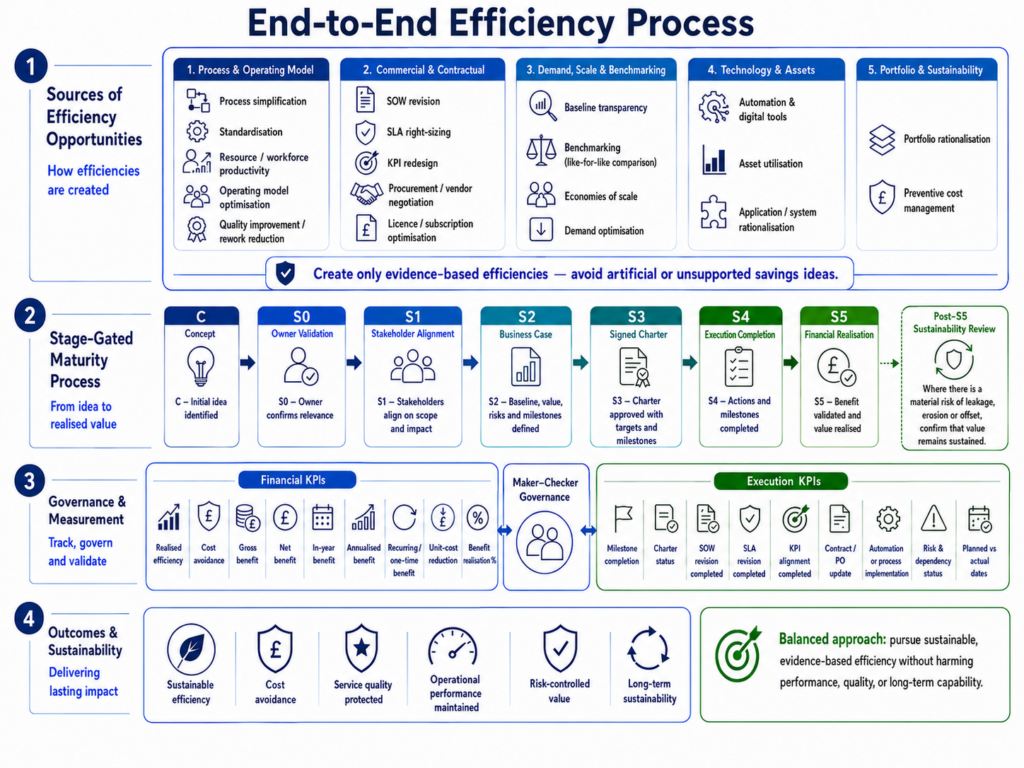
The framework moves an initiative from C (Concept) through six formal maturity stages, with “S” denoting Stage: S0 (Strategic Relevance and Initial Screening), S1 (Ownership and Stakeholder Alignment), S2 (Business Case, Baseline and Operational Acceptance), S3 (Approved Efficiency Charter), S4 (Execution and Operational Handover) and S5 (Validated Value). Operational acceptance at S2 confirms the feasibility of the proposed initiative and the protection of required outcomes before formal commitment, while S4 confirms completed execution and handover. The framework separates execution evidence from value-realisation evidence. The latter comprises Financial KPIs for realised efficiency and cost avoidance and Organisational Outcome KPIs for productivity, capacity, service, risk and strategic value. Evidence-based baselines, maker-checker review, comparable benchmarking and defined decision rights govern progression.
Where material sustainability risk remains, a Post-S5 Sustainability Review tests whether value has endured without unacceptable cost transfer, performance deterioration or capability loss. The model therefore shifts management attention from visible cost reduction to structural change, credible evidence, protected outcomes and sustained enterprise-wide value. The paper offers an adaptable governance architecture and seven propositions for future empirical testing.
Scroll to read the preview. Download for the complete document.
Anderson, M., Banker, R., & Janakiraman, S. (2003). Are Selling, General, and Administrative Costs “Sticky”? Journal of Accounting Research, 41, 47–63. https://doi.org/10.1111/1475-679X.00095
Barney, J., & Clark, D. (2007). Firm resources and sustained competitive advantage* (pp. 49–75). https://doi.org/10.1093/oso/9780199277681.003.0003
Berisha, V. (2017). Strategic Management of Costs: A New Tool to Gain Competitive Advantage (pp. 239–254). https://doi.org/10.1007/978-3-319-48454-9_17
Breese, R. (2012). Benefits realisation management: Panacea or false dawn? International Journal of Project Management, 30, 341–351. https://doi.org/10.1016/j.ijproman.2011.08.007
Chatburn, R., & Ford, R. (2006). Procedure to Normalise Data for Benchmarking. Respiratory Care, 51, 145–157. https://doi.org/10.4187/respcare.06510145
Cooper, R. G. (1990). Stage-gate systems: A new tool for managing new products. Business Horizons, 33(3), 44–54. https://doi.org/10.1016/0007-6813(90)90040-I
Eisenhardt, K., & Martin, J. (2000). Dynamic Capabilities: What Are They? Strategic Management Journal, 21, 1105–1121. https://doi.org/10.1002/1097-0266(200010/11)21:10/113.0.CO;2-E
Ellram, L. (1995). Total Cost of Ownership: An Analysis Approach for Purchasing. International Journal of Physical Distribution & Logistics Management, 25, 4–23. https://doi.org/10.1108/09600039510099928
Franco-Santos, M., Lucianetti, L., & Bourne, M. (2012). Contemporary performance measurement systems: A review of their consequences and a framework for research. Management Accounting Research, 23, 79–119. https://doi.org/10.1016/j.mar.2012.04.001
Institute of project management. (2026, February 3). Statement of Work (SOW) : Definition, Process & Free Templates. https://instituteprojectmanagement.com/blog/statement-of-work/
Jaakkola, E. (2020). Designing conceptual articles: four approaches. AMS Review, 10. https://doi.org/10.1007/s13162-020-00161-0
Jackson Ted. (2026, January 8). 30 Project Management KPIs That Predict Delivery (2026) | ClearPoint Strategy Blog. https://www.clearpointstrategy.com/blog/important-project-management-kpis
Jerónimo, C., Sempiterno, M., & Pereira, L. (2021). Benefits realisation management: systematic literature review. International Journal of Agile Systems and Management, 14, 333. https://doi.org/10.1504/IJASM.2021.10041669
Kurinna Alina. (2025, November 24). Top 10 essential SLA rules that save your service - Atlassian Community. https://community.atlassian.com/forums/App-Central-articles/Top-10-essential-SLA-rules-that-save-your-service/ba-p/2978934
Kushariyadi, K., Wahid, D., Albashori, M., Rustiawan, I., ARDENNY, A., & Wahyudiyono, W. (2025). Performance Management Based on Key Performance Indicators (KPI) to improve Organizational Effectiveness. Maneggio, 2, 90–102. https://doi.org/10.62872/7yx54j15
Martins Serra, C. E., & Kunc, M. (2015). Benefits Realisation Management and its influence on project success and on the execution of business strategies. International Journal of Project Management, 33, 53–66. https://doi.org/10.1016/j.ijproman.2014.03.011
Moriarty, J., & Smallman, C. (2009). En Route to a Theory of Benchmarking. Benchmarking: An International Journal, 16. https://doi.org/10.1108/14635770910972423
Musawir, A., Martins Serra, C. E., Zwikael, O., & Ali, I. (2017). Project governance, benefit management, and project success: Towards a framework for supporting organizational strategy implementation. International Journal of Project Management, 35, 1658–1672. https://doi.org/10.1016/j.ijproman.2017.07.007
Neely, A., Gregory, M., & Platts, K. (2005). Performance measurement system design: A literature review and research agenda. International Journal of Operations & Production Management, 25, 1228–1263. https://doi.org/10.1108/01443570510633639
Poppo, L., & Zenger, T. (2002). Do Formal Contracts and Relational Governance Function As Substitutes or Complements? Strategic Management Journal, 23, 707–725. https://doi.org/10.1002/smj.249
Porter M.E. (1985). Competitive Advantage Porter, M.E. 166677556024.
Rounaghi, M. M., Jarrar, H., & Dana, L.-P. (2021). Implementation of strategic cost management in manufacturing companies: overcoming costs stickiness and increasing corporate sustainability. Future Business Journal 2021 7:1, 7(1), 31-. https://doi.org/10.1186/S43093-021-00079-4
Selviaridis, K., & Wynstra, F. (2015). Performance-based contracting: A literature review and future research directions. International Journal of Production Research, 53. https://doi.org/10.1080/00207543.2014.978031
Teece, D. (2007). Explicating dynamic capabilities: The nature and microfoundations of (sustainable) enterprise performance. Strategic Management Journal, 28, 1319–1350. https://doi.org/10.1002/smj.640
Weiner, B. (2009). A theory of organizational readiness to change. Implementation Science : IS, 4, 67. https://doi.org/10.1186/1748-5908-4-67
Wirtz, J., & Zeithaml, V. (2015). Cost-Effective Service Excellence: Developing a Conceptual Framework (pp. 547–557).
Wirtz, J., & Zeithaml, V. (2018). Cost-Effective Service Excellence. Journal of the Academy of Marketing Science, 46, 59–80. https://doi.org/10.1007/s11747-017-0560-7

Metrics are updated in real time as the article is accessed and downloaded.
Comments
Leave a Comment