
 Article
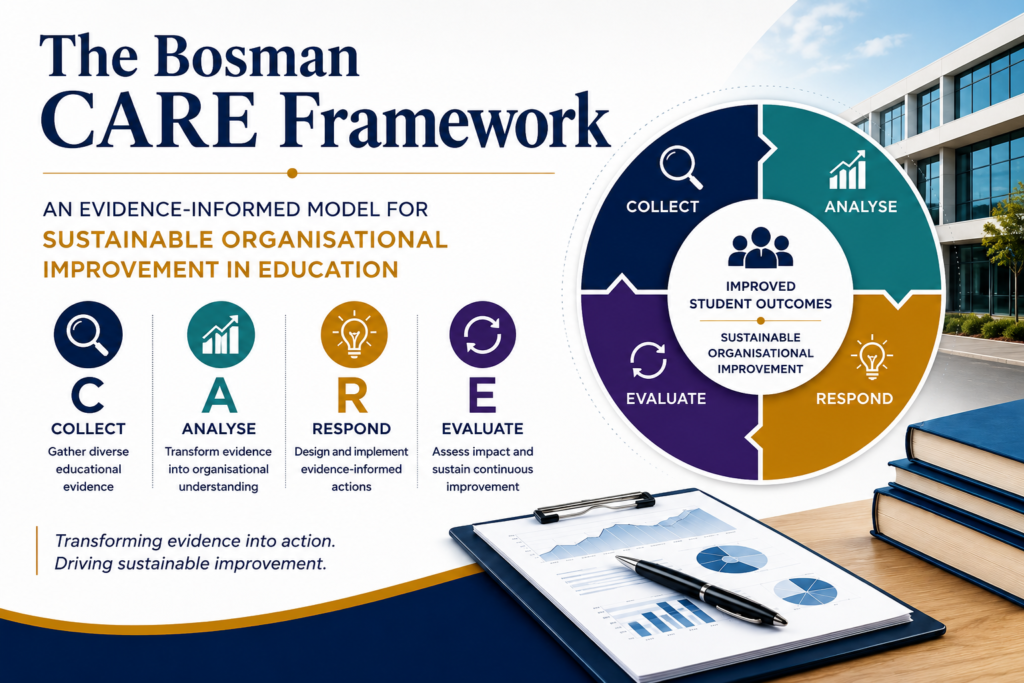
Educational leaders increasingly rely on evidence-informed decision-making to improve teaching, learning and organisational performance. However, existing educational leadership literature provides limited guidance on how diverse forms of educational evidence can be systematically translated into coherent organisational systems that sustain continuous improvement. This paper proposes the Bosman CARE Framework, a conceptual educational leadership framework that integrates evidence-informed leadership, organisational learning, systems thinking and implementation science into a structured process of evidence-informed organisational design.
The framework conceptualises educational leadership as a continuous cycle of Collect, Analyse, Respond and Evaluate (CARE), enabling leaders to transform diverse educational evidence into coherent organisational action. Rather than presenting another leadership style, the framework provides a practical process through which educational leaders design, implement and continuously refine organisational systems that support teaching, learning, professional collaboration and student wellbeing.
Drawing upon contemporary scholarship in educational leadership, organisational learning and school improvement, the paper examines the theoretical foundations of the framework, outlines each stage of the CARE cycle and discusses its implications for evidence-informed leadership. The Bosman CARE Framework contributes to educational leadership scholarship by providing a structured organisational process that integrates established theories into a coherent model for sustainable school improvement. The paper concludes by identifying opportunities for empirical validation across diverse educational contexts.
Keywords: evidence-informed leadership; educational leadership; organisational design; school improvement; implementation fidelity; organisational learning; educational evidence.
Scroll to read the preview. Download for the complete document.
Brown, C. (Ed.). (2015). Leading the use of research and evidence in schools. Institute of Education Press.
Bryk, A. S. (2020). Improvement in action: Advancing quality in America’s schools. Harvard Education Press.
Bryk, A. S., Gomez, L. M., Grunow, A., & LeMahieu, P. G. (2015). Learning to improve: How America’s schools can get better at getting better. Harvard Education Press.
Datnow, A., & Park, V. (2014). Data-driven leadership. Jossey-Bass.
Fixsen, D., Blase, K., Metz, A., & Van Dyke, M. (2013). Statewide implementation of evidence-based programs. Exceptional Children, 79(3), 213–230. https://doi.org/10.1177/001440291307900206
Fullan, M. (2007). The new meaning of educational change (4th ed.). Teachers College Press.
Hallinger, P. (2011). Leadership for learning: Lessons from 40 years of empirical research. Journal of Educational Administration, 49(2), 125–142. https://doi.org/10.1108/09578231111116699
Kemmis, S., McTaggart, R., & Nixon, R. (2014). The action research planner: Doing critical participatory action research. Springer. https://doi.org/10.1007/978-981-4560-67-2
Kızılkaya, E., & Konaklı, T. (2026). We are left alone: Challenges of data use in schools with regard to data-based decision-making steps. European Journal of Education. https://doi.org/10.1111/ejed.70482
Lee, C., Camburn, E. M., & Sebastian, J. (2025). School context, school leaders’ data-informed decision making, and student achievement: Evidence from Florida. School Effectiveness and School Improvement, 36(1), 45–70. https://doi.org/10.1080/09243453.2024.2436889
Leithwood, K., Harris, A., & Hopkins, D. (2020). Seven strong claims about successful school leadership revisited. School Leadership & Management, 40(1), 5–22. https://doi.org/10.1080/13632434.2019.1596077
Leithwood, K., & Jantzi, D. (2005). A review of transformational school leadership research 1996–2005. Leadership and Policy in Schools, 4(3), 177–199. https://doi.org/10.1080/15700760500244769
OpenAI. (2026). ChatGPT (GPT-5.5) [Large language model]. https://chatgpt.com
Pinheiro, G., & Alves, J. M. (2024). Organizational learning within the context of the functioning of educational teams: The progressive emergence of a professional metamorphosis. Education Sciences, 14(3), 247. https://doi.org/10.3390/educsci14030247
Robinson, V. M. J., Lloyd, C. A., & Rowe, K. J. (2008). The impact of leadership on student outcomes: An analysis of the differential effects of leadership types. Educational Administration Quarterly, 44(5), 635–674. https://doi.org/10.1177/0013161X08321509
Rääk, K., & Eisenschmidt, E. (2025). Sustainable evidence-driven school improvement: Routines and data use in Estonian schools. Frontiers in Education, 9, 1517985. https://doi.org/10.3389/feduc.2024.1517985
Senge, P. M. (1990). The fifth discipline: The art and practice of the learning organization. Doubleday.
Spillane, J. P. (2006). Distributed leadership. Jossey-Bass.
Metrics are updated in real time as the article is accessed and downloaded.
Comments
Leave a Comment