
 Article
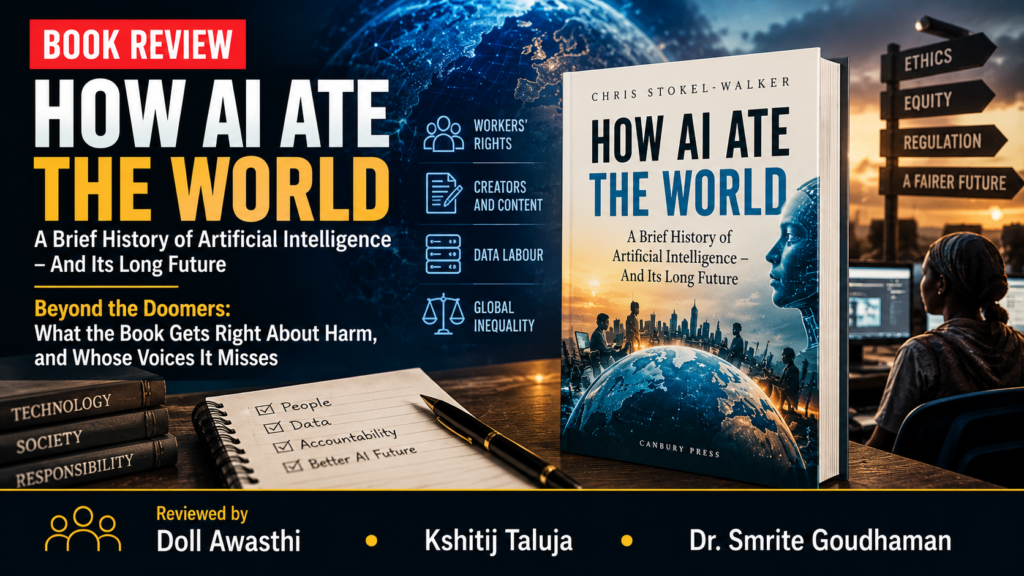
How AI Ate the World by Chris Stokel-Walker explores the history of artificial intelligence and then turns to a documented account of the harms it has already caused, to workers, to creators, and to the information economy, before pivoting to address speculative concerns about an extinction event. This review reads the book in light of its evidentiary method: namely, that it is composed of named, on-record interviews, which lend it a documentary quality that more distanced academic entries would not have. The method is not applied consistently. Western sources are interviewed directly, while Kenyan, Ugandan, and Indian data labourers' situations are reported through other journalists' articles, rather than the author's own. In doing so, Stokel-Walker uses the book to pivot public discourse around specific, documented harms in a direction away from speculation of AI extinction risk and toward the immediately actionable.
Scroll to read the preview. Download for the complete document.
References
Dzieza, J. (2023, June 20). AI is a lot of work. The Verge. https://www.theverge.com/features/23764584/ai-artificial-intelligence-data-notation-labor-scale-surge-remotasks-openai-chatbots
Perrigo, B. (2023, January 18). Exclusive: OpenAI used Kenyan workers on less than $2 per hour to make ChatGPT less toxic. Time. https://time.com/6247678/openai-chatgpt-kenya-workers/
Stokel-Walker, C. (2024). How AI ate the world: A brief history of artificial intelligence – and its long future. Canbury Press.
United Nations. (2015). Transforming our world: The 2030 agenda for sustainable development (A/RES/70/1). https://sdgs.un.org/2030agenda
Wang, D., Prabhat, S., & Sambasivan, N. (2022). Whose AI dream? In search of the aspiration in data annotation. In Proceedings of the 2022 CHI Conference on Human Factors in Computing Systems (Article 267). Association for Computing Machinery. https://doi.org/10.1145/3491102.3502121

Metrics are updated in real time as the article is accessed and downloaded.
Comments
Leave a Comment