
 Article
JOURNAL ARTICLE Algorithmic Content Moderation and Transparency in Social Media: A Comparative Analysis of Systemic and Procedural Transparency by Tanishq Abdus Subhan
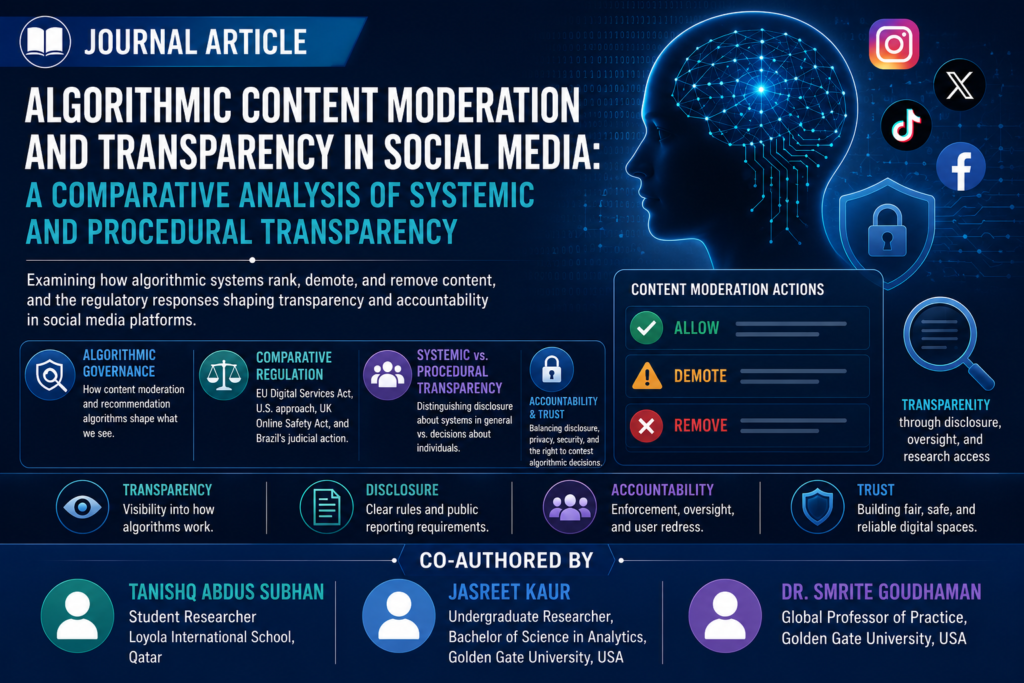
Recommendation and content-moderation algorithms now govern most of what people encounter on social media, replacing simple chronological feeds with systems that rank, demote, and remove content largely out of public view (Gorwa et al., 2020). This article examines why that opacity has become a policy flashpoint, distinguishing between the curatorial function of ranking and recommendation algorithms and the removal function of content moderation, while noting that both raise related concerns about bias, inconsistency, and the limited ability of affected users to contest decisions (Klonick, 2018). It surveys the leading regulatory responses to this problem, focusing on the European Union's Digital Services Act and its enforcement record, the more fragmented and constitutionally constrained approach taken in the United States, the UK's risk-based Online Safety Act, and a contrasting judicial route to platform accountability recently taken by Brazil's Supreme Court. It then turns to the central disagreement in the field: whether mandating disclosure of algorithmic design choices helps or harms the information environment, and whether structured, audited access for vetted researchers offers a workable middle ground between full disclosure and none (Suzor et al., 2019). Drawing on this literature, the article proposes a modest distinction between systemic transparency (disclosure about how a system works in general) and procedural transparency (disclosure to an individual about a specific decision), and argues that current regulation is comparatively well developed on the former and underdeveloped on the latter. The article concludes that transparency is not a single policy lever but a bundle of distinct obligations, that enforcement rather than the mere existence of legislation determines real-world impact, and that procedural transparency toward individual users may matter as much as systemic transparency about how algorithms work in general (Jhaver et al., 2019).
Scroll to read the preview. Download for the complete document.
References
Ananny, M., & Crawford, K. (2018). Seeing without knowing: Limitations of the transparency ideal and its application to algorithmic accountability. New Media & Society, 20(3), 973–989. https://doi.org/10.1177/1461444816676645
Brazilian Federal Supreme Court. (2025). Recurso Extraordinário 1.037.396 and Recurso Extraordinário 1.057.258 (Temas 987 and 533) [Judgment of June 26, 2025].
California State Senate. (2025). Senate Bill No. 771, Personal rights: liability: social media platforms (2025–2026 Reg. Sess.). https://leginfo.legislature.ca.gov/faces/billNavClient.xhtml?bill_id=202520260SB771
Diakopoulos, N. (2015). Algorithmic accountability: Journalistic investigation of computational power structures. Digital Journalism, 3(3), 398–415. https://doi.org/10.1080/21670811.2014.976411
European Commission. (2025a, December 5). Commission fines X €120 million under the Digital Services Act [Press release]. https://digital-strategy.ec.europa.eu/en/news/commission-fines-x-eu120-million-under-digital-services-act
European Commission. (2025b, December 5). Commission accepts TikTok's commitments on advertising transparency under the Digital Services Act [Press release]. https://ec.europa.eu/commission/presscorner/detail/en/ip_25_2940
European Parliament and Council of the European Union. (2022). Regulation (EU) 2022/2065 on a Single Market for Digital Services (Digital Services Act). Official Journal of the European Union, L 277. https://eur-lex.europa.eu/eli/reg/2022/2065/oj
Global Network Initiative. (2025, November 3). From shield to scrutiny: Brazil's Supreme Court redefines platform liability. https://globalnetworkinitiative.org/from-shield-to-scrutiny-brazils-supreme-court-redefines-platform-liability/
Gomez, J. F., Machado, C. V., Paes, L. M., & Calmon, F. P. (2024). Algorithmic arbitrariness in content moderation. In Proceedings of the 2024 ACM Conference on Fairness, Accountability, and Transparency (pp. 2234–2253). Association for Computing Machinery. https://doi.org/10.1145/3630106.3659036
Gorwa, R., Binns, R., & Katzenbach, C. (2020). Algorithmic content moderation: Technical and political challenges in the automation of platform governance. Big Data & Society, 7(1), 1–15. https://doi.org/10.1177/2053951719897945
Jhaver, S., Appling, D. S., Gilbert, E., & Bruckman, A. (2019). “Did you suspect the post would be removed?”: Understanding user reactions to content removals on Reddit. Proceedings of the ACM on Human-Computer Interaction, 3(CSCW), Article 192. https://doi.org/10.1145/3359294
Klonick, K. (2018). The new governors: The people, rules, and processes governing online speech. Harvard Law Review, 131(6), 1598–1670.
Linklaters. (2025, September). The Online Safety Act 2023 – the landscape two years on. https://www.linklaters.com/en/insights/blogs/digilinks/2025/september/uk-the-online-safety-act-2023-the-landscape-two-years-on
Milano, S., Taddeo, M., & Floridi, L. (2020). Recommender systems and their ethical challenges. AI & Society, 35(4), 957–967. https://doi.org/10.1007/s00146-020-00950-y
Myers West, S. (2018). Censored, suspended, shadowbanned: User interpretations of content moderation on social media platforms. New Media & Society, 20(11), 4366–4383. https://doi.org/10.1177/1461444818773059
Ohme, J., & Seiling, L. K. (2026). Finally, access: How Article 40 DSA changes platform research in practice. Political Communication. https://doi.org/10.1080/10584609.2026.2664157
Reuters. (2026, February 25). UK investigates porn site operator Kick under online safety law. https://www.deccanherald.com/world/uk-investigates-porn-site-operator-kick-under-online-safety-law-3540170
Selbst, A. D., & Powles, J. (2017). Meaningful information and the right to explanation. International Data Privacy Law, 7(4), 233–242. https://doi.org/10.1093/idpl/ipx022
Suzor, N. P., Myers West, S., Quodling, A., & York, J. (2019). What do we mean when we talk about transparency? Toward meaningful transparency in commercial content moderation. International Journal of Communication, 13, 1526–1543.
UK Parliament. (2023). Online Safety Act 2023, c. 50. https://www.legislation.gov.uk/ukpga/2023/50/contents
U.S. Congress, Senate. (2021). Filter Bubble Transparency Act, S. 2024, 117th Cong. https://www.congress.gov/bill/117th-congress/senate-bill/2024
Vaccaro, K., Sandvig, C., & Karahalios, K. (2020). “At the end of the day Facebook does what it wants”: How users experience contesting algorithmic content moderation. Proceedings of the ACM on Human-Computer Interaction, 4(CSCW2), Article 167. https://doi.org/10.1145/3415238
Wachter, S., Mittelstadt, B., & Floridi, L. (2017). Why a right to explanation of automated decision-making does not exist in the General Data Protection Regulation. International Data Privacy Law, 7(2), 76–99. https://doi.org/10.1093/idpl/ipx005

Metrics are updated in real time as the article is accessed and downloaded.
Comments
Leave a Comment