
 Article
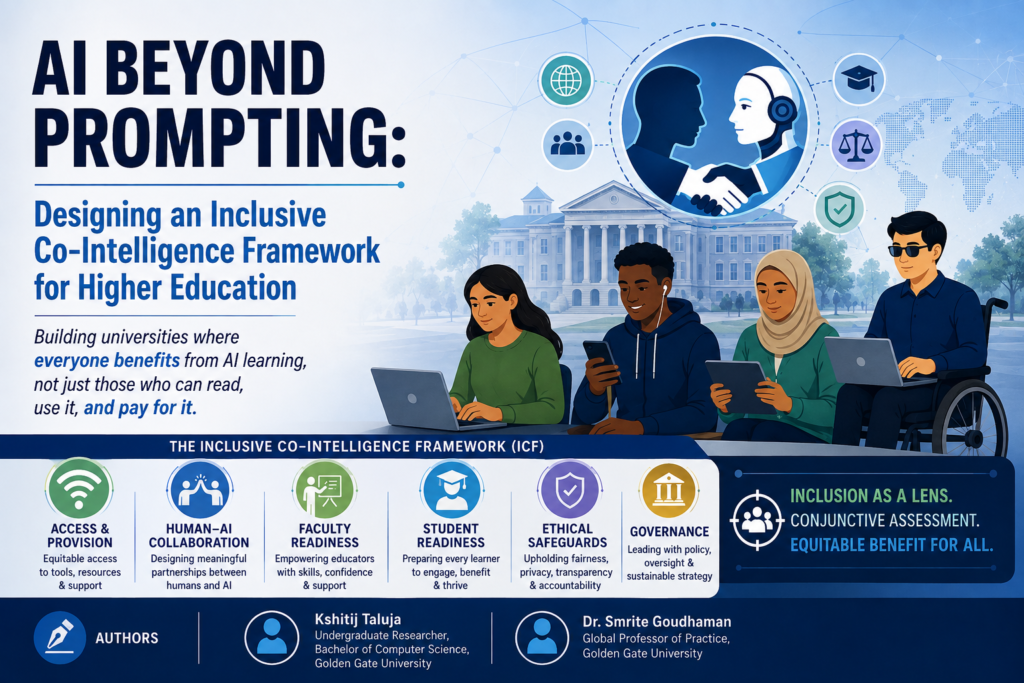
Mollick is asking us to see AI as a partner. However, this article is asking universities an even bigger question: how can a university ensure that everyone benefits from AI, not only those able to read it, use it, and afford it? The article takes the viewpoint of resource-constrained higher education, in which language proficiency, disability status, connectivity, and cost can shape who benefits. Research shows that technology tends to accentuate existing differences rather than reduce them, and scholarship on digital inclusion says access alone does not mean similar benefits. This article presents the Inclusive Co-Intelligence Framework (ICF), developed by synthesizing literature on digital inequality, AI ethics, accessibility, and institutional preparedness. The framework applies inclusion as a cross-cutting lens across six institutional decision domains: access and provision, human-AI collaboration design, faculty readiness, student readiness, ethical safeguards, and governance and accountability. Each is rated on a continuum from absent to embedded. Assessment is therefore conjunctive: strength in one area does not offset weakness in another. This article is conceptual and its worked example is fictional; the framework is offered as a design tool and as a vehicle for future action-research cycles.
Scroll to read the preview. Download for the complete document.
Baker, R. S., & Hawn, A. (2022). Algorithmic bias in education. International Journal of Artificial Intelligence in Education, 32(4), 1052–1092. https://doi.org/10.1007/s40593-021-00285-9
Chan, C. K. Y., & Hu, W. (2023). Students’ voices on generative AI: Perceptions, benefits, and challenges in higher education. International Journal of Educational Technology in Higher Education, 20, Article 43. https://doi.org/10.1186/s41239-023-00411-8
Dell’Acqua, F., McFowland, E., III, Mollick, E. R., Lifshitz, H., Kellogg, K. C., Rajendran, S., Krayer, L., Candelon, F., & Lakhani, K. R. (2026). Navigating the jagged technological frontier: Field experimental evidence of the effects of artificial intelligence on knowledge worker productivity and quality. Organization Science, 37(2), 403–423. https://doi.org/10.1287/orsc.2025.21838
Digital Education Council. (2025). Ten dimension AI readiness framework. https://www.digitaleducationcouncil.com/resource-library-items/ten-dimension-ai-readiness-framework
EDUCAUSE. (2024). Higher education generative AI readiness assessment. https://library.educause.edu/resources/2024/4/higher-education-generative-ai-readiness-assessment
Goudhaman, S., & Taluja, K. (2026, July 28). Co-intelligence: Living and working with AI [Book review]. European International University Publishing. https://publishing.eiu.ac/research-article/co-intelligence-living-and-working-with-ai/
Hargittai, E. (2002). Second-level digital divide: Differences in people’s online skills. First Monday, 7(4). https://doi.org/10.5210/fm.v7i4.942
Holmes, W., Bialik, M., & Fadel, C. (2019). Artificial intelligence in education: Promises and implications for teaching and learning. Center for Curriculum Redesign.
Jaakkola, E. (2020). Designing conceptual articles: Four approaches. AMS Review, 10(1–2), 18–26. https://doi.org/10.1007/s13162-020-00161-0
Jobin, A., Ienca, M., & Vayena, E. (2019). The global landscape of AI ethics guidelines. Nature Machine Intelligence, 1(9), 389–399. https://doi.org/10.1038/s42256-019-0088-2
Jöhnk, J., Weißert, M., & Wyrtki, K. (2021). Ready or not, AI comes: An interview study of organisational AI readiness factors. Business & Information Systems Engineering, 63(1), 5–20. https://doi.org/10.1007/s12599-020-00676-7
Meyer, A., Rose, D. H., & Gordon, D. (2014). Universal design for learning: Theory and practice. CAST Professional Publishing.
Miao, F., & Holmes, W. (2023). Guidance for generative AI in education and research. UNESCO. https://doi.org/10.54675/EWZM9535
Mittelstadt, B. (2019). Principles alone cannot guarantee ethical AI. Nature Machine Intelligence, 1(11), 501–507. https://doi.org/10.1038/s42256-019-0114-4
Mollick, E. (2024). Co-intelligence: Living and working with AI. Portfolio/Penguin.
Noy, S., & Zhang, W. (2023). Experimental evidence on the productivity effects of generative artificial intelligence. Science, 381(6654), 187–192. https://doi.org/10.1126/science.adh2586
OECD. (2019). Recommendation of the Council on Artificial Intelligence (OECD/LEGAL/0449). https://legalinstruments.oecd.org/en/instruments/OECD-LEGAL-0449
Paulk, M. C., Curtis, B., Chrissis, M. B., & Weber, C. V. (1993). Capability maturity model for software (Version 1.1). Software Engineering Institute, CMU/SEI-93-TR-024. https://doi.org/10.1184/R1/6575027.v1
Toyama, K. (2015). Geek heresy: Rescuing social change from the cult of technology. PublicAffairs.
UNESCO. (2019). Beijing Consensus on Artificial Intelligence and Education. UNESCO. https://unesdoc.unesco.org/ark:/48223/pf0000368303
UNESCO. (2021). Recommendation on the Ethics of Artificial Intelligence. UNESCO. https://www.unesco.org/en/legal-affairs/recommendation-ethics-artificial-intelligence
UNESCO. (2023, September). UNESCO survey: Less than 10% of schools and universities have formal guidance on AI. UNESCO. https://www.unesco.org/en/articles/unesco-survey-less-10-schools-and-universities-have-formal-guidance-ai
UNESCO. (2025, September). UNESCO survey: Two-thirds of higher education institutions have or are developing guidance on AI use. UNESCO. https://www.unesco.org/en/articles/unesco-survey-two-thirds-higher-education-institutions-have-or-are-developing-guidance-ai-use
van Deursen, A. J. A. M., & Helsper, E. J. (2015). The third-level digital divide: Who benefits most from being online? In L. Robinson, S. R. Cotten, J. Schulz, T. M. Hale, & A. Williams (Eds.), Communication and information technologies annual (Studies in Media and Communications, Vol. 10, pp. 29–52). Emerald. https://doi.org/10.1108/S2050-206020150000010002
W3C. (2023). Web Content Accessibility Guidelines (WCAG) 2.2. W3C Recommendation. https://www.w3.org/TR/WCAG22/
Warschauer, M. (2003). Technology and social inclusion: Rethinking the digital divide. MIT Press.
Webster, J., & Watson, R. T. (2002). Analyzing the past to prepare for the future: Writing a literature review. MIS Quarterly, 26(2), xiii–xxiii.
Zawacki-Richter, O., Marín, V. I., Bond, M., & Gouverneur, F. (2019). Systematic review of research on artificial intelligence applications in higher education: Where are the educators? International Journal of Educational Technology in Higher Education, 16, Article 39. https://doi.org/10.1186/s41239-019-0171-0

Metrics are updated in real time as the article is accessed and downloaded.
Comments
1Leave a Comment
Magnificent composition✨