
 Article
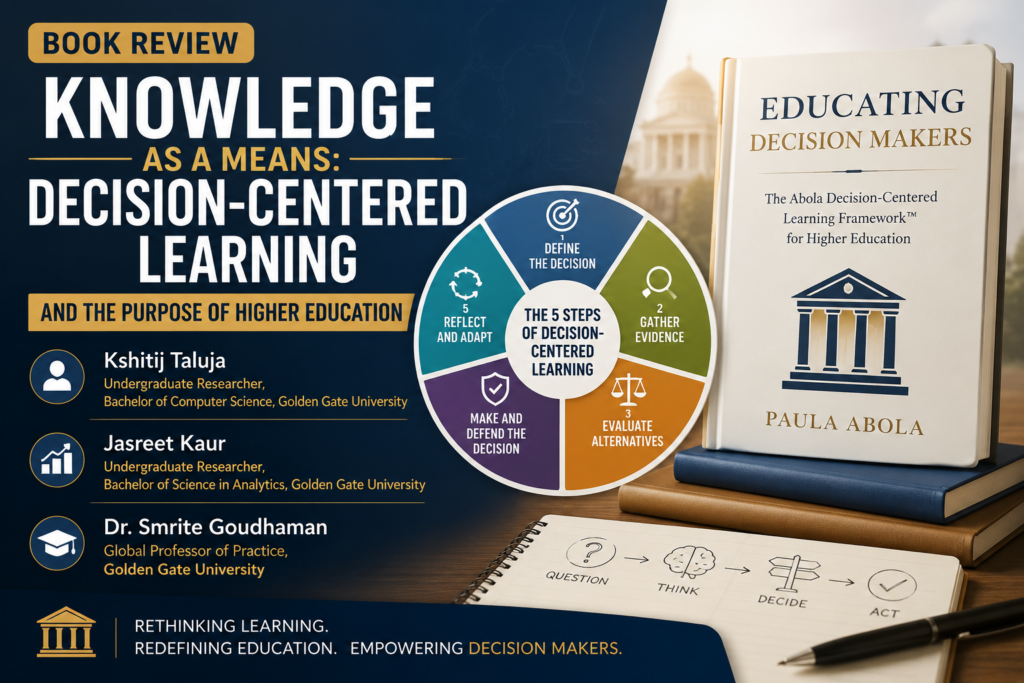
Educating Decision Makers posits that developing knowledge alone will not enable students to make decisions when faced with uncertainty, and instead proposes a new way of organizing curricula based on the kinds of decisions graduates are expected to make as opposed to what graduates are expected to know. This evaluation reviews that proposal along with the impacts of the proposed change on how courses are designed and assessed, and ultimately, how institutions function. What distinguishes this review is its attention to how the book utilizes the epistemology of evidence-based clinical practice to inform curriculum theory. That is an observation regarding the book's intellectual heritage as opposed to a claim that it has originated something unique within the field. The main unresolved issue is the apparent contradiction between the author's stated intent to utilize the framework to assess student decision-making capabilities across all fields, and her acknowledgment that assessing decision-making through decision-centered assessments can be inconsistent.
Scroll to read the preview. Download for the complete document.
Abola, P. (2026). Educating decision makers: The Abola Decision-Centered Learning Framework™ for higher education. EIU Press.
Barrows, H. S., & Tamblyn, R. M. (1980). Problem-based learning: An approach to medical education. Springer.
Biggs, J., & Tang, C. (2011). Teaching for quality learning at university (4th ed.). Open University Press.
Bloom, B. S., Engelhart, M. D., Furst, E. J., Hill, W. H., & Krathwohl, D. R. (1956). Taxonomy of educational objectives: Handbook I: Cognitive domain. David McKay.
Dewey, J. (1938). Experience and education. Macmillan.
Gaba, D. M. (2004). The future vision of simulation in health care. Quality and Safety in Health Care, 13(Suppl 1), i2–i10. https://doi.org/10.1136/qshc.2004.009878
Garvin, D. A. (2003). Making the case: Professional education for the world of practice. Harvard Magazine, 106(1), 56–65.
Gulikers, J. T. M., Bastiaens, T. J., & Kirschner, P. A. (2004). A five-dimensional framework for authentic assessment. Educational Technology Research and Development, 52(3), 67–86. https://doi.org/10.1007/BF02504676
Hammond, J. S., Keeney, R. L., & Raiffa, H. (1999). Smart choices: A practical guide to making better decisions. Harvard Business School Press.
Kahneman, D., & Tversky, A. (1984). Choices, values, and frames. American Psychologist, 39(4), 341–350. https://doi.org/10.1037/0003-066X.39.4.341
Sackett, D. L., Rosenberg, W. M. C., Gray, J. A. M., Haynes, R. B., & Richardson, W. S. (1996). Evidence based medicine: What it is and what it isn't. BMJ, 312(7023), 71–72. https://doi.org/10.1136/bmj.312.7023.71
Simon, H. A. (1997). Administrative behavior: A study of decision-making processes in administrative organizations (4th ed.). Free Press. (Original work published 1947)
Wiggins, G., & McTighe, J. (2005). Understanding by design (2nd ed.). Association for Supervision and Curriculum Development.

Metrics are updated in real time as the article is accessed and downloaded.
Comments
Leave a Comment