
 Article
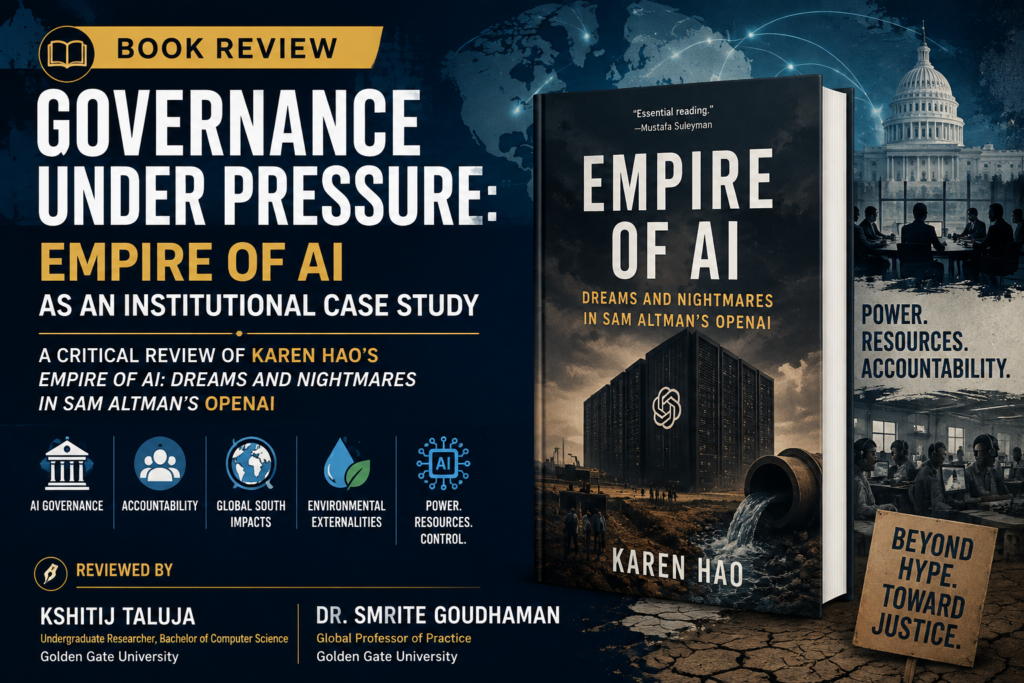
Karen Hao's Empire of AI claims that the most influential artificial intelligence (AI) labs function as empires, using their size to extract labor, energy, land, and data from people who reap very few benefits. This book review examines Empire of AI as a case study of how institutions govern missions when they are under pressure from capital, instead of looking at the empire model that it uses. This review therefore concentrates on the documentary evidence the book presents. In particular, the book reconstructs the governance structure of OpenAI in detail through interviews with approximately 260 different people and a review of internal documents, and reports on the outsourcing of data labor in Kenya and water and energy usage in Chile and Uruguay. One conceptual limitation of the imperial model is that it locates where harm occurs more precisely than it explains how that harm might be addressed. As such, the main contribution of the book is documentation of the authority structures, dependency on capital, and outsourced risks.
Scroll to read the preview. Download for the complete document.
Hao, K. (2025). Empire of AI: Dreams and nightmares in Sam Altman's OpenAI. Penguin Press.
Li, P., Yang, J., Islam, M. A., & Ren, S. (2023). Making AI less “thirsty”: Uncovering and addressing the secret water footprint of AI models (arXiv:2304.03271). arXiv. https://doi.org/10.48550/arXiv.2304.03271
Mohamed, S., Png, M.-T., & Isaac, W. (2020). Decolonial AI: Decolonial theory as sociotechnical foresight in artificial intelligence. Philosophy & Technology, 33(4), 659–684. https://doi.org/10.1007/s13347-020-00405-8
United Nations. (2015). Transforming our world: The 2030 agenda for sustainable development (A/RES/70/1). https://sdgs.un.org/2030agenda

Metrics are updated in real time as the article is accessed and downloaded.
Comments
Leave a Comment