
 Article
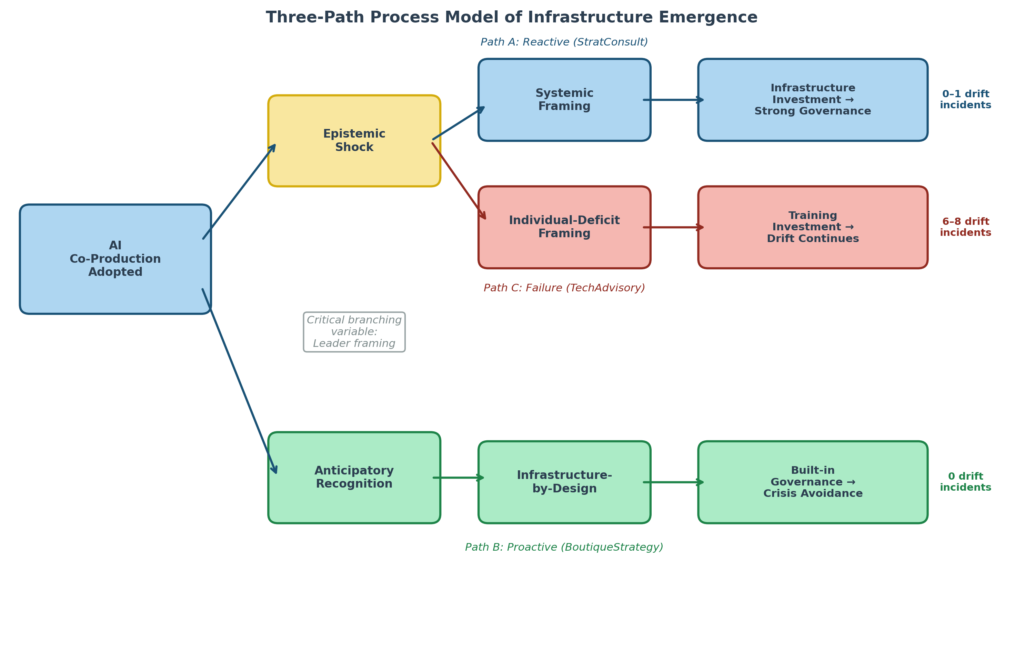
Organisational theory has long been divided between structural accounts of knowledge governance and agentic accounts of professional judgment. Artificial intelligence (AI) unsettles both: it severs the link between production and accountability while generating the very fluency markers professionals use to assess quality. Through comparative case analysis of six professional services organisations (127 interviews, 43 documents, and 22 observation sessions over 11 months), this study develops a grounded theory of epistemic governance through infrastructuring, the deliberate design of background systems that make the epistemic status of knowledge claims visible and actionable. The study describes a confidence-decoupling phenomenon, a self-reinforcing pattern in which AI-enhanced surface quality raises organisational confidence even as epistemic quality declines, connecting it to March’s (1991) exploitation trap. It develops a three-path process model showing how leaders’ framing of epistemic shocks is associated with whether organisations build infrastructure or continue to drift. A three-type reality-infrastructure typology, comprising provenance systems, accountability structures, and legitimised contestation, was associated with substantially different outcomes. These case-level patterns are interpretive rather than statistical: across our cases, strong-infrastructure organisations recorded far fewer epistemic drift incidents (zero to one over 18 months) than weak-infrastructure organisations using comparable AI tools (six to eight). The findings contribute to debates on sociomaterial organising, the micro-foundations of institutionalisation, and the conditions under which professional judgment can be exercised under algorithmic co-production.
Scroll to read the preview. Download for the complete document.
Adler, P. S., & Borys, B. (1996). Two types of bureaucracy: Enabling and coercive. Administrative Science Quarterly, 41(1), 61–89.
Ananny, M., & Crawford, K. (2018). Seeing without knowing: Limitations of the transparency ideal and its application to algorithmic accountability. New Media & Society, 20(3), 973–989.
Bandura, A. (2001). Social cognitive theory: An agentic perspective. Annual Review of Psychology, 52, 1–26.
Barley, S. R. (1986). Technology as an occasion for structuring: Evidence from observations of CT scanners and the social order of radiology departments. Administrative Science Quarterly, 31(1), 78–108.
Barley, S. R., & Tolbert, P. S. (1997). Institutionalization and structuration: Studying the links between action and institution. Organization Studies, 18(1), 93–117.
Bender, E. M., Gebru, T., McMillan-Major, A., & Shmitchell, S. (2021). On the dangers of stochastic parrots: Can language models be too big? In Proceedings of the 2021 ACM Conference on Fairness, Accountability, and Transparency (pp. 610–623). Association for Computing Machinery.
Bowker, G. C., & Star, S. L. (2000). Sorting things out: Classification and its consequences. MIT Press.
Charmaz, K. (2006). Constructing grounded theory. Sage.
Charmaz, K. (2014). Constructing grounded theory (2nd ed.). Sage.
Crevani, L., & Endrissat, N. (2016). Mapping the leadership-as-practice terrain. In J. A. Raelin (Ed.), Leadership-as-practice: Theory and application (pp. 21–49). Routledge.
Dell’Acqua, F., McFowland, E., Mollick, E. R., Lifshitz-Assaf, H., Kellogg, K., Rajendran, S., Krayer, L., Candelon, F., & Lakhani, K. R. (2023). Navigating the jagged technological frontier: Field experimental evidence of the effects of AI on knowledge worker productivity and quality (Working Paper No. 24-013). Harvard Business School.
Denis, J.-L., Langley, A., & Rouleau, L. (2010). The practice of leadership in the messy world of organizations. Leadership, 6(1), 67–88.
Emirbayer, M., & Mische, A. (1998). What is agency? American Journal of Sociology, 103(4), 962–1023.
Empson, L., Muzio, D., Broschak, J. P., & Hinings, B. (Eds.). (2015). The Oxford handbook of professional service firms. Oxford University Press.
Floridi, L., & Chiriatti, M. (2020). GPT-3: Its nature, scope, limits, and consequences. Minds and Machines, 30(4), 681–694.
Giddens, A. (1984). The constitution of society: Outline of the theory of structuration. University of California Press.
Goldberg, S. C. (2010). Relying on others: An essay in epistemology. Oxford University Press.
Goldberg, S. C. (2018). To the best of our knowledge: Social expectations and epistemic normativity. Oxford University Press.
Kellogg, K. C., Valentine, M. A., & Christin, A. (2020). Algorithms at work: The new contested terrain of control. Academy of Management Annals, 14(1), 366–410.
Lebovitz, S., Lifshitz-Assaf, H., & Levina, N. (2024). Generative AI and the disruption of expertise: The effects of AI writing assistance on expert knowledge networks. Organization Science, 35(1), 279–302.
Leonardi, P. M. (2011). When flexible routines meet flexible technologies: Affordance, constraint, and the imbrication of human and material agencies. MIS Quarterly, 35(1), 147–167.
Lindsley, D. H., Brass, D. J., & Thomas, J. B. (1995). Efficacy-performance spirals: A multilevel perspective. Academy of Management Review, 20(3), 645–678.
March, J. G. (1991). Exploration and exploitation in organizational learning. Organization Science, 2(1), 71–87.
Möhlmann, M., Zalmanson, L., Henfridsson, O., & Gregory, R. W. (2021). Algorithmic management of work on online labor platforms: When matching meets control. MIS Quarterly, 45(4), 1999–2022.
Orlikowski, W. J. (2000). Using technology and constituting structures: A practice lens for studying technology in organizations. Organization Science, 11(4), 404–428.
Raelin, J. A. (2011). From leadership-as-practice to leaderful practice. Leadership, 7(2), 195–211.
Scott, W. R. (2001). Institutions and organizations (2nd ed.). Sage.
Sperber, D., Clément, F., Heintz, C., Mascaro, O., Mercier, H., Origgi, G., & Wilson, D. (2010). Epistemic vigilance. Mind & Language, 25(4), 359–393.
Star, S. L., & Ruhleder, K. (1996). Steps toward an ecology of infrastructure: Design and access for large information spaces. Information Systems Research, 7(1), 111–134.
Weick, K. E. (1995). Sensemaking in organizations. Sage.
Metrics are updated in real time as the article is accessed and downloaded.
Comments
Leave a Comment