
 Article
Abstract
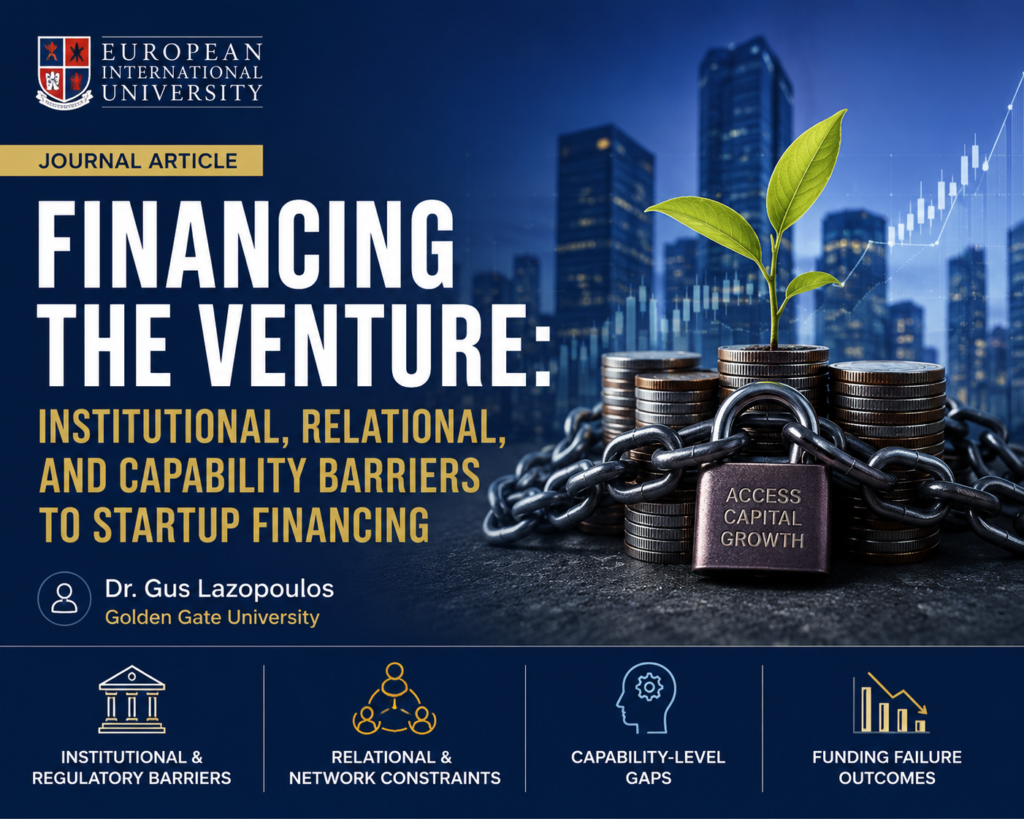
Despite a substantial body of research on entrepreneurial finance, little is known about how founders themselves experience and interpret the failure to secure capital. This study investigates startup funding failure as a multi-level phenomenon by centering the lived experiences of entrepreneurs based primarily in the United States and Canada. Drawing on semi-structured interviews with ten participants, including early-stage and serial founders, startup consultants, incubator and ecosystem professionals, and investor-side intermediaries, we use reflexive thematic analysis to surface the structural, relational, and psychological mechanisms that interrupt the financing process. Funding failure emerges as neither random nor primarily a function of business quality. It arises from the interaction of institutional and regulatory asymmetries that create unequal access to capital, capability gaps in financial literacy and investor readiness, and misalignments between entrepreneurial ambition, venture maturity, and investor expectations. We engage these findings with pecking order theory, the resource-based view, and capital structure theory, and show that each framework, while illuminating, cannot fully account for the emotional, relational, and institutional dimensions that shape financing outcomes in practice. An integrative conceptual model of startup funding failure is proposed, together with implications for theory, practice, and policy.
Scroll to read the preview. Download for the complete document.
Adhabi, E., & Anozie, C. B. (2017). Literature review for the type of interview in qualitative research. International Journal of Education, 9(3), 86–97.
Adwani, R. (2025). Innovative financing models for startups: Challenges and opportunities in a globalized economy [Working paper]. SSRN. https://doi.org/10.2139/ssrn.5162026
Amankwah-Amoah, J., Khan, Z., Ifere, S. E., Nyuur, R. B., & Khan, H. (2022). Entrepreneurs' learning from business failures: An emerging market perspective. British Journal of Management, 33(4), 1735–1756. https://doi.org/10.1111/1467-8551.12557
Amoa-Gyarteng, K. (2023). Entrepreneurial resilience: Gleaning valuable insights from start-up failures for a path to success [Preprint]. EconStor. http://hdl.handle.net/10419/274527
Braun, V., & Clarke, V. (2006). Using thematic analysis in psychology. Qualitative Research in Psychology, 3(2), 77–101. https://doi.org/10.1191/1478088706qp063oa
Brusov, P., & Filatova, T. (2023). Capital structure theory: Past, present, future. Mathematics, 11(3), 616. https://doi.org/10.3390/math11030616
Eisenhardt, K. M. (1989). Building theories from case study research. Academy of Management Review, 14(4), 532–550. https://doi.org/10.2307/258557
Frank, M. Z., Goyal, V. K., & Shen, T. (2020). The pecking order theory of capital structure: Where do we stand? In Oxford research encyclopedia of economics and finance. Oxford University Press. https://doi.org/10.2139/ssrn.3540610
Freeman, R. E., Dmytriyev, S. D., & Phillips, R. A. (2021). Stakeholder theory and the resource-based view of the firm. Journal of Management, 47(7), 1757–1770. https://doi.org/10.1177/0149206321993576
Goswami, N., Murti, A. B., & Dwivedi, R. (2023). Why do Indian startups fail? A narrative analysis of key business stakeholders. Indian Growth and Development Review, 16(2), 141–157. https://doi.org/10.1108/IGDR-11-2022-0136
Jaggurotu, N., Aggarwal, H., Dixit, H., & Mohan, C. (2024). The role of financial mismanagement in early startup failures. Journal of Emerging Technologies and Innovative Research, 11(10), g48–g55. http://www.jetir.org/papers/JETIR2410606.pdf
Jamshed, S. (2014). Qualitative research method: Interviewing and observation. Journal of Basic and Clinical Pharmacy, 5(4), 87–88. https://doi.org/10.4103/0976-0105.141942
Lange, J., Rezepa, S., & Zatrochová, M. (2024). The role of business angels in the early-stage financing of startups: A systematic literature review. Administrative Sciences, 14(10), 247. https://doi.org/10.3390/admsci14100247
Lattacher, W., & Wdowiak, M. A. (2020). Entrepreneurial learning from failure: A systematic review. International Journal of Entrepreneurial Behavior & Research, 26(5), 1093–1131. https://doi.org/10.1108/IJEBR-02-2019-0085
Lincoln, Y. S., & Guba, E. G. (1985). Naturalistic inquiry. Sage.
Majumdar, R. (2020). Finding new frontiers: The challenges of early-stage Indian entrepreneurs in accessing finance in an evolving startup ecosystem. In Entrepreneurial finance in emerging markets (pp. 193–211). Springer. https://doi.org/10.1007/978-3-030-46220-8_13
Miller, D. (2019). The resource-based view of the firm. In Oxford research encyclopedia of business and management. Oxford University Press. https://doi.org/10.1093/acrefore/9780190224851.013.4
Naeem, M., Ozuem, W., Howell, K., & Ranfagni, S. (2023). A step-by-step process of thematic analysis to develop a conceptual model in qualitative research. International Journal of Qualitative Methods, 22. https://doi.org/10.1177/16094069231205789
Oranburg, S. C. (2020). Start-up financing. In Start-up creation (pp. 59–79). Woodhead Publishing. https://doi.org/10.1016/B978-0-12-819946-6.00004-7
Pallathadka, H. (2022). Challenges for financing startups in China: A quantitative investigation of small and medium ventures. Integrated Journal for Research in Arts and Humanities, 2(6), 232–238. https://doi.org/10.55544/ijrah.2.6.31
Prohorovs, A., Bistrova, J., & Ten, D. (2019). Startup success factors in the capital attraction stage: Founders' perspective. Journal of East-West Business, 25(1), 26–51. https://doi.org/10.1080/10669868.2018.1503211
Quas, A., Mason, C., Compañó, R., Testa, G., & Gavigan, J. P. (2022). The scale-up finance gap in the EU: Causes, consequences, and policy solutions. European Management Journal, 40(5), 645–652. https://doi.org/10.1016/j.emj.2022.08.003
Saleem, M., & Atiq, M. (2023). Challenges faced by startups in accessing external financing. International Journal of Business and Management Sciences, 4(2), 193–202.
Strauss, A., & Corbin, J. (1998). Basics of qualitative research: Techniques and procedures for developing grounded theory (2nd ed.). Sage.
Sukachova, S., Vytrykhovskyi, Y., Korneev, V., Gaponiuk, M., & Borodenko, T. (2025). Innovative startup financing models: Venture capital and crowdfunding. International Journal of Economics and Financial Issues, 15(4), 427–433.
Zapata-Molina, C., Bedoya-Villa, M., Castro-Gómez, J., Gutiérrez-Broncano, S., Román, E., & Rave-Gómez, E. (2025). Factors affecting the financial sustainability of startups during the valley of death: An empirical study in an innovative ecosystem. International Journal of Financial Studies, 13(2), 73. https://doi.org/10.3390/ijfs13020073

Metrics are updated in real time as the article is accessed and downloaded.
Comments
Leave a Comment