
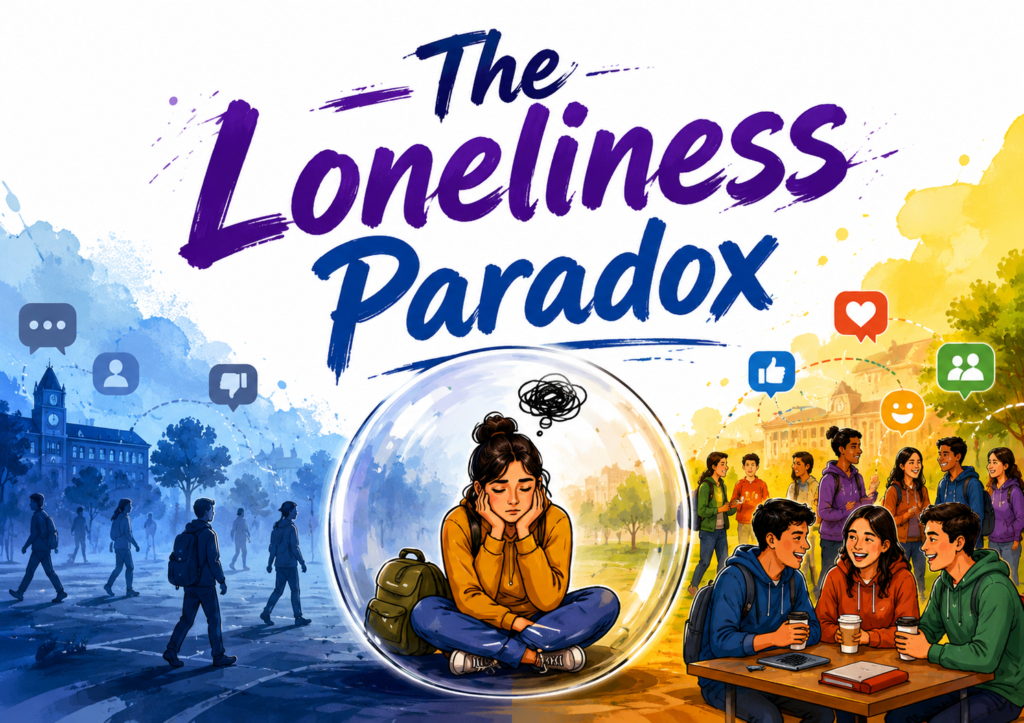
 Poster
International university students today arrive on campus with more digital connections than any previous generation, yet counselling and peer mentor data consistently reveal a troubling paradox: these same students frequently report profound feelings of social isolation and an inability to form meaningful in-person relationships. This poster presents a practice-based inquiry into the Loneliness Paradox — the phenomenon whereby quantitative digital hyperconnectivity coexists with qualitative relational poverty in the lived experience of international students. Drawing on reflective practice data gathered during a six-session relationship skills workshop series with 24 first-year international students representing 11 nationalities, this inquiry examines three interconnected dynamics: the substitution effect, whereby students use digital platforms as a replacement for rather than a scaffold toward in-person relational investment; the disclosure gap, whereby online self-disclosure fails to translate into the sustained and embodied reciprocity required for genuine intimacy; and the comparison trap, whereby exposure to curated social media content systematically elevates relational comparison levels and increases dissatisfaction with real-world connections. Post-workshop data indicated that 79% of participants reported increased confidence in initiating relationships, 88% demonstrated greater cultural communication awareness, and mean relational satisfaction rose from 4.2 to 6.8 on a 10-point scale. A three-stage Digital-to-Physical Relational Transition Model is proposed as a framework for higher education practitioners designing targeted student support interventions. Findings suggest that addressing student loneliness requires moving beyond social events and orientation programmes toward theoretically grounded, practice-based interventions that explicitly teach the skills required to convert digital contact into meaningful in-person connection.
KEYWORDS: digital loneliness, international students, relationship formation, social media, higher education
Scroll to read the preview. Download for the complete document.
Altman, I., & Taylor, D. A. (1973). Social penetration: The development of interpersonal relationships. Holt, Rinehart & Winston.
Ruppel, E. K., Gross, C., Stoll, A., Peck, B. S., Allen, M., & Kim, S. Y. (2017). Reflecting on connecting: Meta-analysis of differences between computer-mediated and face-to-face self-disclosure. Journal of Computer-Mediated Communication, 22(1), 18–34. https://doi.org/10.1111/jcc4.12179
Thibaut, J. W., & Kelley, H. H. (1959). The social psychology of groups. John Wiley & Sons.
Twenge, J. M., Haidt, J., Joiner, T. E., & Campbell, W. K. (2018). Underestimating digital media harm. Nature Human Behaviour, 3(1), 75–76. https://doi.org/10.1038/s41562-018-0506-1
Metrics are updated in real time as the article is accessed and downloaded.
Comments
Leave a Comment