
 Article
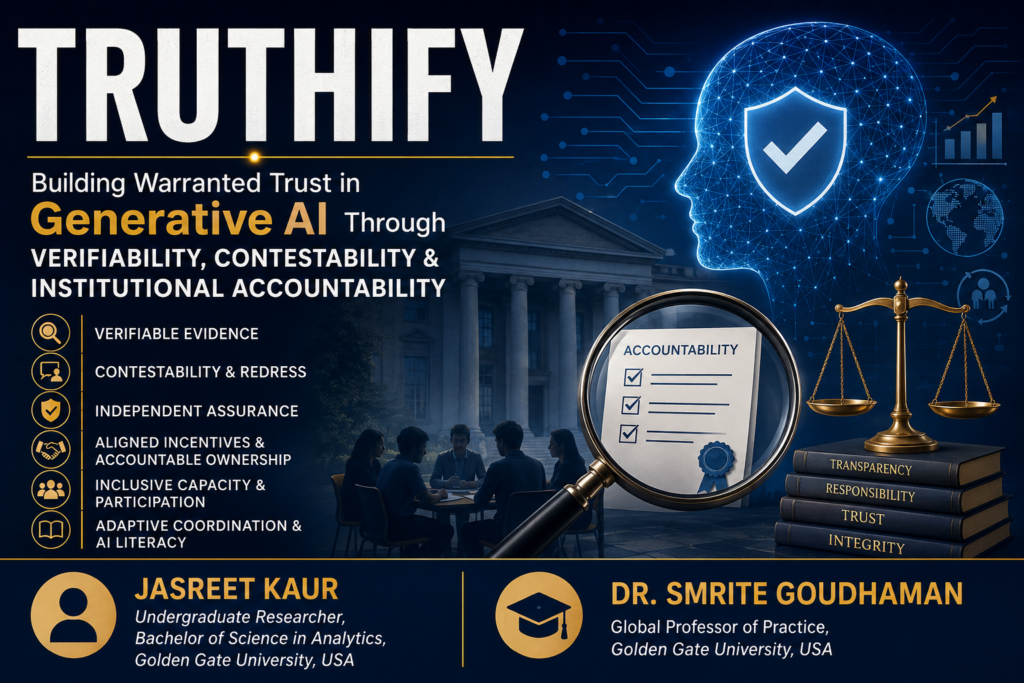
The central problem in the governance of Artificial Intelligence (AI) lies less with a lack of an ethical code for AI. Rather, it is harder to develop those codes into actionable processes that could engender warranted trust in AI. More than just formal commitment is required to do so. Evidence, process clarity, oversight, and the existence of institutions capable of acting when issues arise are all needed. Utilizing literature from fields including AI Ethics, Sociotechnical Accountability, Auditing, Trust, Global Governance, and Education, this conceptual piece identifies the TRUTHIFY framework. The TRUTHIFY framework identifies six governance capabilities that need to be present to enable warranted trust in AI. They include: verifiable evidence; contestability and redress; independent assurance; aligned incentives and accountable ownership; inclusive capacity and participation; and adaptive coordination and AI literacy. All six capabilities are enacted at multiple levels (i.e., user-level and organization-level). Moreover, their ability to function effectively will depend upon a number of exogenous factors such as market pressures, degree of market concentration, geopolitical competition, institutional capacity, and specific risk characteristics of each sector. Finally, five propositions detail how TRUTHIFY's capabilities may facilitate the development of action-oriented practices that embody warranted trust. The paper further illustrates the application of TRUTHIFY's capabilities using Generative AI in Higher Education. This setting shows how TRUTHIFY can inform decisions about procurement, deployment, evaluation and review. The article offers an integrative model for assessing whether claims of responsible AI can be examined, challenged and enforced. Its broader aim is to clarify the conditions under which AI governance can support legitimate and credible reliance on AI systems.
Scroll to read the preview. Download for the complete document.
Birhane, A. (2020). Algorithmic colonization of Africa. SCRIPTed, 17(2), 389-409. https://doi.org/10.2966/scrip.170220.389
Cath, C., Wachter, S., Mittelstadt, B., Taddeo, M., & Floridi, L. (2018). Artificial intelligence and the 'good society': The US, EU and UK approach. Science and Engineering Ethics, 24(2), 505-528. https://doi.org/10.1007/s11948-017-9901-7
Cihon, P., Maas, M. M., & Kemp, L. (2020). Fragmentation and the future: Investigating architectures for international AI governance. Global Policy, 11(5), 545-556. https://doi.org/10.1111/1758-5899.12890
Coalition for Content Provenance and Authenticity. (2026). C2PA technical specification (Version 2.4). https://spec.c2pa.org/specifications/specifications/2.4/index.html
Cobbe, J., Lee, M. S. A., & Singh, J. (2021). Reviewable automated decision-making: A framework for accountable algorithmic systems. In Proceedings of the 2021 ACM Conference on Fairness, Accountability, and Transparency (pp. 598-609). Association for Computing Machinery. https://doi.org/10.1145/3442188.3445921
Council of Europe. (2024). Council of Europe Framework Convention on Artificial Intelligence and Human Rights, Democracy and the Rule of Law (CETS No. 225). https://www.coe.int/en/web/conventions/full-list?module=treaty-detail&treatynum=225
Cotton, D. R. E., Cotton, P. A., & Shipway, J. R. (2024). Chatting and cheating: Ensuring academic integrity in the era of ChatGPT. Innovations in Education and Teaching International, 61(2), 228-239. https://doi.org/10.1080/14703297.2023.2190148
European Parliament and Council of the European Union. (2024). Regulation (EU) 2024/1689 laying down harmonised rules on artificial intelligence. Official Journal of the European Union, L., 2024/1689. https://eur-lex.europa.eu/eli/reg/2024/1689/oj
Floridi, L., Cowls, J., Beltrametti, M., Chatila, R., Chazerand, P., Dignum, V., Luetge, C., Madelin, R., Pagallo, U., Rossi, F., Schafer, B., Valcke, P., & Vayena, E. (2018). AI4People - An ethical framework for a good AI society: Opportunities, risks, principles, and recommendations. Minds and Machines, 28(4), 689-707. https://doi.org/10.1007/s11023-018-9482-5
Gasser, U., & Almeida, V. A. F. (2017). A layered model for AI governance. IEEE Internet Computing, 21(6), 58-62. https://doi.org/10.1109/MIC.2017.4180835
Gebru, T., Morgenstern, J., Vecchione, B., Vaughan, J. W., Wallach, H., Daume III, H., & Crawford, K. (2021). Datasheets for datasets. Communications of the ACM, 64(12), 86-92. https://doi.org/10.1145/3458723
Glikson, E., & Woolley, A. W. (2020). Human trust in artificial intelligence: Review of empirical research. Academy of Management Annals, 14(2), 627-660. https://doi.org/10.5465/annals.2018.0057
Jaakkola, E. (2020). Designing conceptual articles: Four approaches. AMS Review, 10, 18-26. https://doi.org/10.1007/s13162-020-00161-0
Jacovi, A., Marasovic, A., Miller, T., & Goldberg, Y. (2021). Formalizing trust in artificial intelligence: Prerequisites, causes and goals of human trust in AI. In Proceedings of the 2021 ACM Conference on Fairness, Accountability, and Transparency (pp. 624-635). Association for Computing Machinery. https://doi.org/10.1145/3442188.3445923
Jobin, A., Ienca, M., & Vayena, E. (2019). The global landscape of AI ethics guidelines. Nature Machine Intelligence, 1, 389-399. https://doi.org/10.1038/s42256-019-0088-2
Kroll, J. A., Huey, J., Barocas, S., Felten, E. W., Reidenberg, J. R., Robinson, D. G., & Yu, H. (2017). Accountable algorithms. University of Pennsylvania Law Review, 165(3), 633-705. https://scholarship.law.upenn.edu/penn_law_review/vol165/iss3/3/
Metcalf, J., Moss, E., Watkins, E. A., Singh, R., & Elish, M. C. (2021). Algorithmic impact assessments and accountability: The co-construction of impacts. In Proceedings of the 2021 ACM Conference on Fairness, Accountability, and Transparency (pp. 735-746). Association for Computing Machinery. https://doi.org/10.1145/3442188.3445935
Mittelstadt, B. (2019). Principles alone cannot guarantee ethical AI. Nature Machine Intelligence, 1, 501-507. https://doi.org/10.1038/s42256-019-0114-4
Mitchell, M., Wu, S., Zaldivar, A., Barnes, P., Vasserman, L., Hutchinson, B., Spitzer, E., Raji, I. D., & Gebru, T. (2019). Model cards for model reporting. In Proceedings of the Conference on Fairness, Accountability, and Transparency (pp. 220-229). Association for Computing Machinery. https://doi.org/10.1145/3287560.3287596
Mohamed, S., Png, M.-T., & Isaac, W. (2020). Decolonial AI: Decolonial theory as sociotechnical foresight in artificial intelligence. Philosophy & Technology, 33, 659-684. https://doi.org/10.1007/s13347-020-00405-8
Mökander, J., Axente, M., Casolari, F., & Floridi, L. (2021). Ethics-based auditing of automated decision-making systems: Nature, scope, and limitations. Science and Engineering Ethics, 27, Article 44. https://doi.org/10.1007/s11948-021-00319-4
Mökander, J., Schuett, J., Kirk, H. R., & Floridi, L. (2024). Auditing large language models: A three-layered approach. AI and Ethics, 4, 1085-1115. https://doi.org/10.1007/s43681-023-00289-2
Morley, J., Floridi, L., Kinsey, L., & Elhalal, A. (2020). From what to how: An initial review of publicly available AI ethics tools, methods and research to translate principles into practices. Science and Engineering Ethics, 26, 2141-2168. https://doi.org/10.1007/s11948-019-00165-5
National Institute of Standards and Technology. (2023). Artificial Intelligence Risk Management Framework (AI RMF 1.0) (NIST AI 100-1). U.S. Department of Commerce. https://doi.org/10.6028/NIST.AI.100-1
National Institute of Standards and Technology. (2024). Artificial Intelligence Risk Management Framework: Generative Artificial Intelligence Profile (NIST AI 600-1). U.S. Department of Commerce. https://doi.org/10.6028/NIST.AI.600-1
Raji, I. D., Smart, A., White, R. N., Mitchell, M., Gebru, T., Hutchinson, B., Smith-Loud, J., Theron, D., & Barnes, P. (2020). Closing the AI accountability gap: Defining an end-to-end framework for internal algorithmic auditing. In Proceedings of the 2020 Conference on Fairness, Accountability, and Transparency (pp. 33-44). Association for Computing Machinery. https://doi.org/10.1145/3351095.3372873
Sambasivan, N., Arnesen, E., Hutchinson, B., Doshi, T., & Prabhakaran, V. (2021). Re-imagining algorithmic fairness in India and beyond. In Proceedings of the 2021 ACM Conference on Fairness, Accountability, and Transparency (pp. 315-328). Association for Computing Machinery. https://doi.org/10.1145/3442188.3445896
Selbst, A. D., Boyd, D., Friedler, S. A., Venkatasubramanian, S., & Vertesi, J. (2019). Fairness and abstraction in sociotechnical systems. In Proceedings of the Conference on Fairness, Accountability, and Transparency (pp. 59-68). Association for Computing Machinery. https://doi.org/10.1145/3287560.3287598
Snyder, H. (2019). Literature review as a research methodology: An overview and guidelines. Journal of Business Research, 104, 333-339. https://doi.org/10.1016/j.jbusres.2019.07.039
Toreini, E., Aitken, M., Coopamootoo, K., Elliott, K., Gonzalez Zelaya, C., & van Moorsel, A. (2020). The relationship between trust in AI and trustworthy machine learning technologies. In Proceedings of the 2020 Conference on Fairness, Accountability, and Transparency (pp. 272-283). Association for Computing Machinery. https://doi.org/10.1145/3351095.3372834
United Nations. (2024). Governing AI for humanity: Final report of the High-level Advisory Body on Artificial Intelligence. https://www.un.org/sites/un2.un.org/files/governing_ai_for_humanity_final_report_en.pdf
United Nations General Assembly. (2025). Terms of reference and modalities for the establishment and functioning of the Independent International Scientific Panel on Artificial Intelligence and the Global Dialogue on Artificial Intelligence Governance (A/RES/79/325). United Nations. https://digitallibrary.un.org/record/4087699
UNESCO. (2021). Recommendation on the ethics of artificial intelligence. https://unesdoc.unesco.org/ark:/48223/pf0000381137
UNESCO. (2023). Guidance for generative AI in education and research. https://unesdoc.unesco.org/ark:/48223/pf0000386693
UNESCO. (2024a). AI competency framework for students. https://unesdoc.unesco.org/ark:/48223/pf0000391105
UNESCO. (2024b). AI competency framework for teachers. https://unesdoc.unesco.org/ark:/48223/pf0000391104
Whetten, D. A. (1989). What constitutes a theoretical contribution? Academy of Management Review, 14(4), 490-495. https://doi.org/10.5465/amr.1989.4308371
Wieringa, M. (2020). What to account for when accounting for algorithms: A systematic literature review on algorithmic accountability. In Proceedings of the 2020 Conference on Fairness, Accountability, and Transparency (pp. 1-18). Association for Computing Machinery. https://doi.org/10.1145/3351095.3372833

Metrics are updated in real time as the article is accessed and downloaded.
Comments
Leave a Comment