
 Article
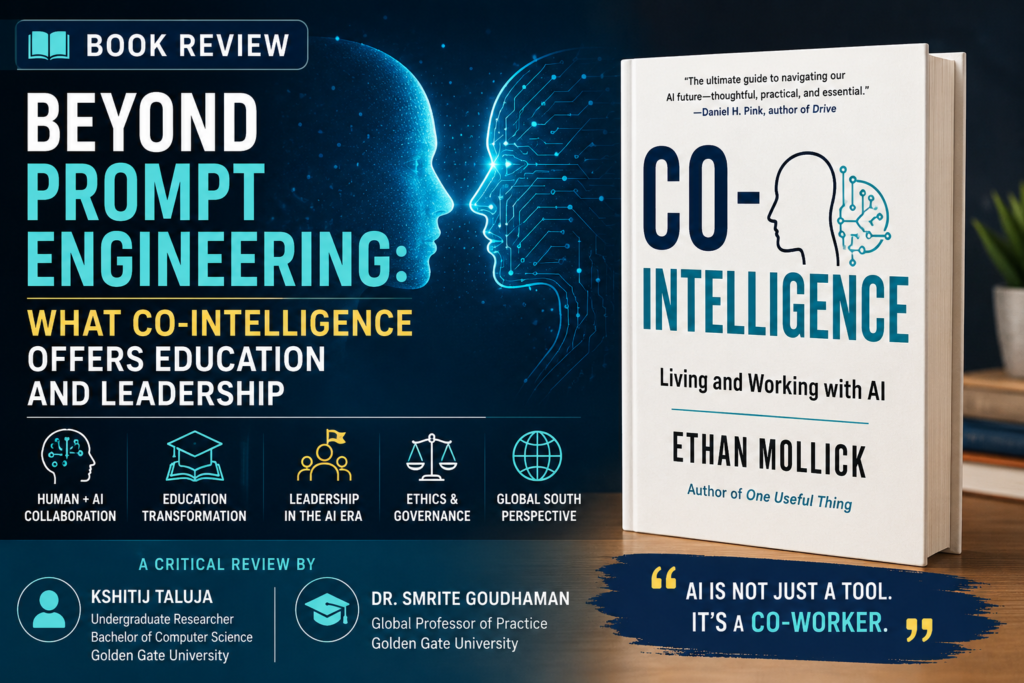
Co-Intelligence: Living and Working With AI by Ethan Mollick discusses how generative artificial intelligence (AI) can serve as a "capable, yet imperfect" co-laborer, in addition to being seen as a substitute for human judgment. While this reviewer agrees with many aspects of Mollick's four guidelines, which provide useful direction for user-level practitioners, the review identifies several institutional barriers to implementing these recommendations on a larger scale. The review considers the book from the vantage points of higher education, leadership, governance, costs associated with implementation, educational equity; and the reality of the Global South as well as the labor required to support the use of these technologies. In general, Co-Intelligence provides an excellent introduction to thinking about the ethical considerations involved in adopting AI responsibly. However, there are other organizational, policy, and equity related issues that readers will also need to consider beyond those addressed within the confines of this book.
Scroll to read the preview. Download for the complete document.
References
Bloom, B. S. (1984). The 2 sigma problem: The search for methods of group instruction as effective as one-to-one tutoring. Educational Researcher, 13(6), 4–16. https://doi.org/10.3102/0013189X013006004
Dell’Acqua, F., McFowland, E., III, Mollick, E. R., Lifshitz-Assaf, H., Kellogg, K., Rajendran, S., Krayer, L., Candelon, F., & Lakhani, K. R. (2023). Navigating the jagged technological frontier: Field experimental evidence of the effects of AI on knowledge worker productivity and quality (Harvard Business School Working Paper No. 24-013). https://doi.org/10.2139/ssrn.4573321
Miao, F., & Holmes, W. (2023). Guidance for generative AI in education and research. UNESCO. https://doi.org/10.54675/EWZM9535
Mollick, E. (2024). Co-intelligence: Living and working with AI. Portfolio/Penguin.
Noy, S., & Zhang, W. (2023). Experimental evidence on the productivity effects of generative artificial intelligence. Science, 381(6654), 187–192. https://doi.org/10.1126/science.adh2586
OECD. (2019). Recommendation of the Council on Artificial Intelligence (OECD/LEGAL/0449). https://legalinstruments.oecd.org/en/instruments/OECD-LEGAL-0449
United Nations. (2015). Transforming our world: The 2030 Agenda for Sustainable Development (A/RES/70/1). https://sdgs.un.org/2030agenda

Metrics are updated in real time as the article is accessed and downloaded.
Comments
4I thoroughly enjoyed reading this review. It is exceptionally well-written, insightful, and remarkably balanced. What impressed me most was how it went beyond simply summarizing the book and thoughtfully explored important themes such as institutional readiness, educational equity, ethical considerations, and the real-world challenges of implementing AI in education. The discussion of the Global South and the broader policy implications added a unique and valuable perspective that made the review even more compelling. Despite the complexity of the topic, the writing remained clear, engaging, and accessible throughout. This review not only deepened my understanding of the subject but also sparked my curiosity to read the book itself. An outstanding piece of writing that I would highly recommend to anyone interested in the future of AI and education.
I found this review of Co-Intelligence: Living and Working with AI to be both insightful and highly relevant. Rather than simply outlining Ethan Mollick's ideas, it critically examines the practical challenges of implementing AI across education, leadership, governance, and society. I especially appreciated how the review highlights the importance of institutional readiness, ethical responsibility, and equitable access, particularly from the perspective of the Global South. It presents a balanced evaluation by acknowledging the strengths of the book while encouraging readers to think beyond individual AI use toward broader policy and organizational considerations. Overall, this is a well-researched and thought-provoking review that adds valuable perspective and fosters meaningful discussion about the responsible integration of AI. Excellent work by the authors.
I really enjoyed reading this review. What I liked most was that it does much more than summarise the book. The discussion on institutional readiness, educational equity and the practical challenges of implementing AI recommendations gives readers a broader perspective on the topic. Even for someone without a technical background, the ideas are presented in a clear and engaging way. It is thoughtful, well-structured and encourages readers to explore the book for themselves. As your sister, I am incredibly proud to see the effort and dedication reflected in your work. Wishing you many more such achievements in the future.
Leave a Comment
I found this review to be exceptionally well written and thoughtfully balanced. What stood out to me was that it did not simply summarize the book but also examined important issues such as institutional readiness, educational equity, and the practical challenges of implementing AI recommendations on a larger scale. The discussion on the realities of the Global South and the broader policy considerations added depth to the review. Even without a technical background, I found it engaging, easy to follow, and genuinely informative. It is the kind of review that encourages readers to explore the book themselves.