
 Article
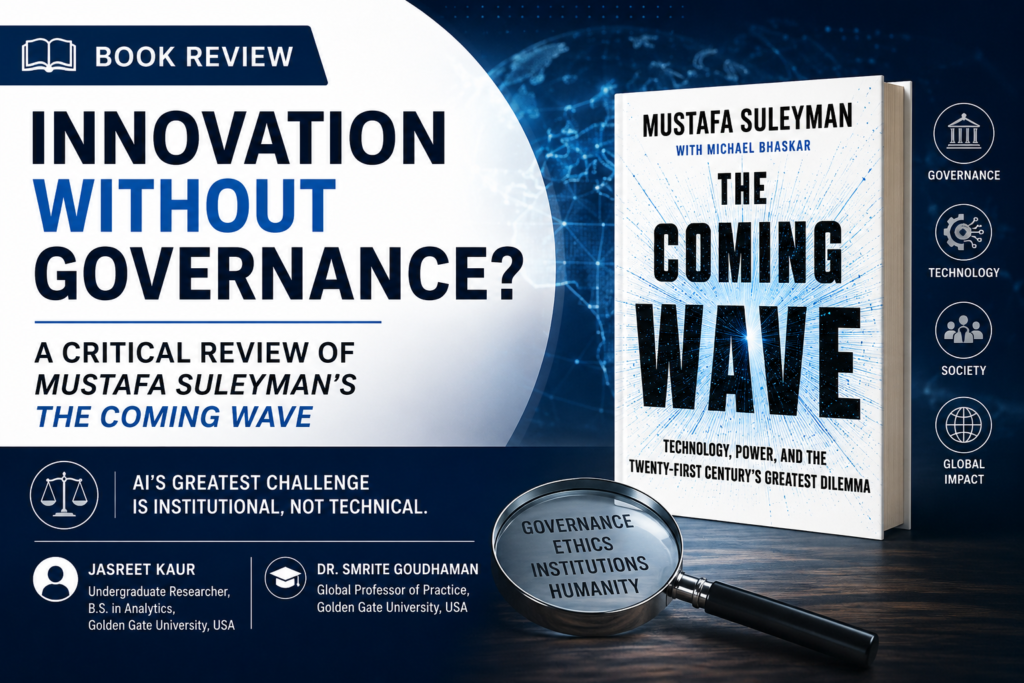
This review assesses Mustafa Suleyman’s The Coming Wave (2023) based on seven categories: clarity, originality, institutional feasibility, geopolitical realism, policy relevance, inclusion and applicability. In terms of its most significant contributions, The Coming Wave has effectively framed AI safety as an institutional and governance challenge rather than simply being a technical problem. However, Suleyman's containment framework remains inadequately developed due to the fact that it does not provide sufficient detail regarding how institutions, geopolitics, and implementations can be put into place so that containment can withstand both domestic and inter-state competition.
Scroll to read the preview. Download for the complete document.
Birhane, A. (2020). Algorithmic colonization of Africa. SCRIPTed, 17(2), 389–409. https://doi.org/10.2966/scrip.170220.389
European Union. (2024). Regulation (EU) 2024/1689 laying down harmonised rules on artificial intelligence (Artificial Intelligence Act). Official Journal of the European Union, L, 2024/1689.
Holmes, W., Bialik, M., & Fadel, C. (2019). Artificial intelligence in education: Promises and implications for teaching and learning. Center for Curriculum Redesign.
National Institute of Standards and Technology. (2023). Artificial intelligence risk management framework (AI RMF 1.0) (NIST AI 100-1). U.S. Department of Commerce. https://doi.org/10.6028/NIST.AI.100-1
Organisation for Economic Co-operation and Development. (2019). Recommendation of the Council on Artificial Intelligence (OECD/LEGAL/0449). OECD.
Selwyn, N. (2019). Should robots replace teachers? AI and the future of education. Polity Press.
Suleyman, M., & Bhaskar, M. (2023). The coming wave: Technology, power and the twenty-first century’s greatest dilemma. Crown.
UNESCO. (2021). Recommendation on the ethics of artificial intelligence. UNESCO. https://unesdoc.unesco.org/ark:/48223/pf0000381137
United Nations. (2015). Transforming our world: The 2030 Agenda for Sustainable Development (A/RES/70/1). United Nations General Assembly.

Metrics are updated in real time as the article is accessed and downloaded.
Comments
4Reading this review of The Coming Wave was a genuinely rewarding experience. What impressed me most was that it goes far beyond merely summarizing Mustafa Suleyman’s arguments. Instead, it thoughtfully evaluates the book through multiple dimensions, including clarity, originality, institutional feasibility, geopolitical realism, policy relevance, inclusion, and practical applicability. The review effectively captures the book’s most significant contribution—its powerful argument that AI safety is fundamentally a challenge of governance and institutions, rather than a purely technical issue.
At the same time, the review demonstrates intellectual honesty by recognizing the limitations of Suleyman’s containment framework. It persuasively points out that while the vision is compelling, it leaves important questions unanswered regarding institutional implementation, geopolitical cooperation, and the practical realities of managing competition within and across nations. This balanced perspective strengthens the credibility of the review, encouraging readers to engage critically with the book rather than accepting its arguments at face value.
What I appreciated most was the reviewer’s ability to connect technological innovation with the broader realities of public policy, governance, and global collaboration. It reminds us that transformative technologies can create lasting value only when they are supported by robust institutions and thoughtful policymaking. The writing is clear, insightful, and accessible, making complex ideas understandable without sacrificing analytical depth.
More than anything, this review reflects careful reading, independent thinking, and academic maturity. It offers meaningful insights that extend well beyond a conventional book summary and inspires readers to reflect on the future of AI with both optimism and responsibility. I am genuinely impressed by the quality of this work and truly proud of the reviewer for producing such a thoughtful, balanced, and intellectually engaging piece.
Reading this review of The Coming Wave was a genuinely rewarding experience. What impressed me most was that it goes far beyond merely summarizing Mustafa Suleyman’s arguments. Instead, it thoughtfully evaluates the book through multiple dimensions, including clarity, originality, institutional feasibility, geopolitical realism, policy relevance, inclusion, and practical applicability. The review effectively captures the book’s most significant contribution—its powerful argument that AI safety is fundamentally a challenge of governance and institutions, rather than a purely technical issue.
At the same time, the review demonstrates intellectual honesty by recognizing the limitations of Suleyman’s containment framework. It persuasively points out that while the vision is compelling, it leaves important questions unanswered regarding institutional implementation, geopolitical cooperation, and the practical realities of managing competition within and across nations. This balanced perspective strengthens the credibility of the review, encouraging readers to engage critically with the book rather than accepting its arguments at face value.
What I appreciated most was the reviewer’s ability to connect technological innovation with the broader realities of public policy, governance, and global collaboration. It reminds us that transformative technologies can create lasting value only when they are supported by robust institutions and thoughtful policymaking. The writing is clear, insightful, and accessible, making complex ideas understandable without sacrificing analytical depth.
More than anything, this review reflects careful reading, independent thinking, and academic maturity. It offers meaningful insights that extend well beyond a conventional book summary and inspires readers to reflect on the future of AI with both optimism and responsibility. I am genuinely impressed by the quality of this work and truly proud of the reviewer for producing such a thoughtful, balanced, and intellectually engaging piece.
I found this review of The Coming Wave to be exceptionally insightful and well-structured. Rather than merely summarizing the book, it thoughtfully explores the broader implications of artificial intelligence, governance, ethics, and institutional responsibility. The analysis presents complex ideas in a clear and engaging manner, making them accessible while encouraging readers to reflect critically on the challenges posed by rapidly advancing technologies. I especially appreciated the balanced perspective and the emphasis on the importance of effective governance in shaping the future of AI. This is a compelling and intellectually stimulating review that goes beyond a conventional book summary and leaves readers with meaningful questions to consider. Excellent work by the authors.
Leave a Comment
I was genuinely impressed by the depth and clarity of this review of The Coming Wave. Rather than simply summarizing the book, it thoughtfully examines important aspects such as institutional feasibility, policy implementation, and the geopolitical challenges surrounding emerging technologies. I particularly appreciated how the review emphasizes that technological progress must be supported by effective governance and strong institutions to achieve meaningful outcomes. It presents the book's central arguments in a balanced and accessible manner while also encouraging readers to think critically about the broader implications of AI and other transformative technologies. It is a carefully written review that adds valuable perspective beyond a conventional summary. I am truly proud of her.