
 Article
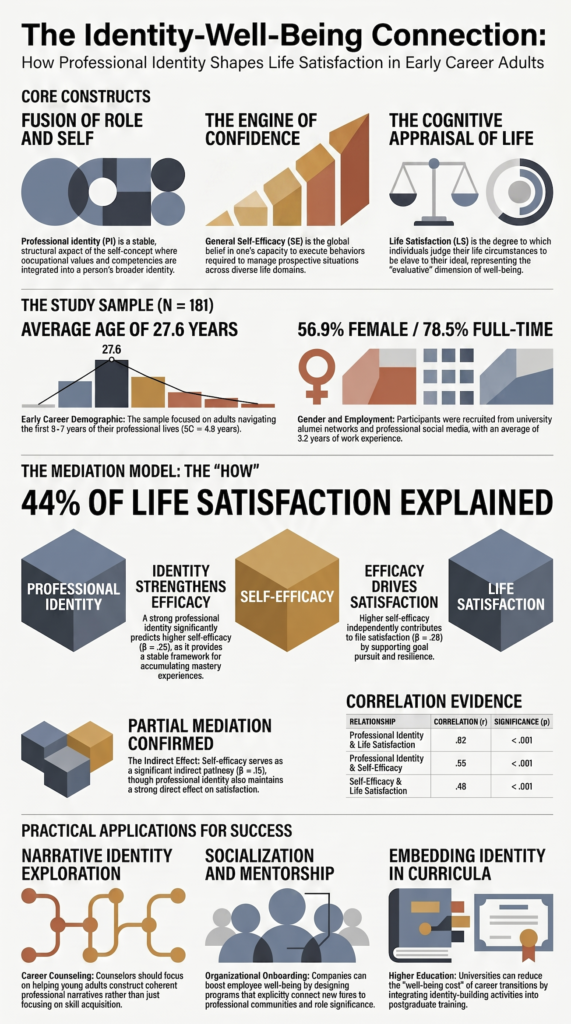
Background: Professional identity — the degree to which individuals integrate their occupational role into their broader self-concept — has been theorized as a key determinant of subjective well-being. Yet the psychological mechanisms through which professional identity translates into life satisfaction remain underexplored, particularly among early career adults navigating the complex transition from education into the labor market.
Aim: The present study examined whether general self-efficacy mediates the relationship between professional identity and life satisfaction in a sample of early career adults.
Design and Sample: A cross-sectional online survey design was employed with a convenience sample of N = 181 early career adults (M age = 27.6 years, SD = 4.9; 56.9% female). Measures included the Professional Identity Scale (PIS; α = .91), the General Self-Efficacy Scale (α = .88), and the Satisfaction with Life Scale (SWLS; α = .89).
Results: Pearson correlations revealed significant positive associations among all three constructs (professional identity–life satisfaction: r = .62, p < .001; professional identity–self-efficacy: r = .55, p < .001; self-efficacy–life satisfaction: r = .48, p < .001). Mediation analysis using PROCESS Model 4 (Hayes, 2018) with 5,000 bootstrap resamples indicated a significant indirect effect of professional identity on life satisfaction through self-efficacy (β = .15, 95% CI [.07, .25]), alongside a significant direct effect (β = .46, p < .001), supporting partial mediation.
Conclusion: These findings suggest that while professional identity directly contributes to life satisfaction, a meaningful portion of this effect operates indirectly through enhanced self-efficacy beliefs.
Scroll to read the preview. Download for the complete document.
Ashforth, B. E., & Mael, F. (1989). Social identity theory and the organization. Academy of Management Review, 14(1), 20–39. https://doi.org/10.5465/amr.1989.4278999
Bandura, A. (1977). Self-efficacy: Toward a unifying theory of behavioral change. Psychological Review, 84(2), 191–215. https://doi.org/10.1037/0033-295X.84.2.191
Bandura, A. (1997). Self-efficacy: The exercise of control. Freeman.
Brown, R., Condor, S., Mathews, A., Wade, G., & Williams, J. (1986). Explaining intergroup differentiation in an industrial organization. Journal of Occupational Psychology, 59(4), 273–286. https://doi.org/10.1111/j.2044-8325.1986.tb00229.x
Deci, E. L., & Ryan, R. M. (2000). The “what” and “why” of goal pursuits: Human needs and the self-determination of behavior. Psychological Inquiry, 11(4), 227–268. https://doi.org/10.1207/S15327965PLI1104_01
Diener, E. (1984). Subjective well-being. Psychological Bulletin, 95(3), 542–575. https://doi.org/10.1037/0033-2909.95.3.542
Diener, E., Emmons, R. A., Larsen, R. J., & Griffin, S. (1985). The Satisfaction with Life Scale. Journal of Personality Assessment, 49(1), 71–75. https://doi.org/10.1207/s15327752jpa4901_13
Dobrow, S. R., & Tosti-Kharas, J. (2011). Calling: The development of a scale measure. Personnel Psychology, 64(4), 1001–1049. https://doi.org/10.1111/j.1744-6570.2011.01234.x
Erikson, E. H. (1968). Identity: Youth and crisis. Norton.
Harter, J. K., Schmidt, F. L., & Keyes, C. L. M. (2002). Well-being in the workplace and its relationship to business outcomes: A review of the Gallup studies. In C. L. M. Keyes & J. Haidt (Eds.), Flourishing: Positive psychology and the life well-lived (pp. 205–224). American Psychological Association.
Hayes, A. F. (2018). Introduction to mediation, moderation, and conditional process analysis: A regression-based approach (2nd ed.). Guilford Press.
Ibarra, H. (1999). Provisional selves: Experimenting with image and identity in professional adaptation. Administrative Science Quarterly, 44(4), 764–791. https://doi.org/10.2307/2667055
Judge, T. A., & Bono, J. E. (2001). Relationship of core self-evaluations traits — self-esteem, generalized self-efficacy, locus of control, and emotional stability — with job satisfaction and job performance: A meta-analysis. Journal of Applied Psychology, 86(1), 80–92. https://doi.org/10.1037/0021-9010.86.1.80
Judge, T. A., & Watanabe, S. (1993). Another look at the job satisfaction–life satisfaction relationship. Journal of Applied Psychology, 78(6), 939–948. https://doi.org/10.1037/0021-9010.78.6.939
Kalleberg, A. L. (2009). Precarious work, insecure workers: Employment relations in transition. American Sociological Review, 74(1), 1–22. https://doi.org/10.1177/000312240907400101
Lewin, K. (1946). Action research and minority problems. Journal of Social Issues, 2(4), 34–46. https://doi.org/10.1111/j.1540-4560.1946.tb02295.x
Luthans, F., Youssef, C. M., & Avolio, B. J. (2007). Psychological capital: Developing the human competitive edge. Oxford University Press.
Maslach, C., Jackson, S. E., & Leiter, M. P. (1996). Maslach Burnout Inventory manual (3rd ed.). Consulting Psychologists Press.
Ng, T. W. H., Eby, L. T., Sorensen, K. L., & Feldman, D. C. (2005). Predictors of objective and subjective career success: A meta-analysis. Personnel Psychology, 58(2), 367–408. https://doi.org/10.1111/j.1744-6570.2005.00515.x
Pavot, W., & Diener, E. (1993). Review of the Satisfaction with Life Scale. Psychological Assessment, 5(2), 164–172. https://doi.org/10.1037/1040-3590.5.2.164
Podsakoff, P. M., MacKenzie, S. B., Lee, J.-Y., & Podsakoff, N. P. (2003). Common method biases in behavioral research: A critical review of the literature and recommended remedies. Journal of Applied Psychology, 88(5), 879–903. https://doi.org/10.1037/0021-9010.88.5.879
Preacher, K. J., & Hayes, A. F. (2008). Asymptotic and resampling strategies for assessing and comparing indirect effects in multiple mediator models. Behavior Research Methods, 40(3), 879–891. https://doi.org/10.3758/BRM.40.3.879
Saks, A. M., Uggerslev, K. L., & Fassina, N. E. (2007). Socialization tactics and newcomer adjustment: A meta-analytic review and test of a model. Journal of Vocational Behavior, 70(3), 413–446. https://doi.org/10.1016/j.jvb.2006.12.004
Savickas, M. L. (2002). Career construction: A developmental theory of vocational behavior. In D. Brown & Associates (Eds.), Career choice and development (4th ed., pp. 149–205). Jossey-Bass.
Scherer, R. F., Maddux, J. E., Mercandante, B., Prentice-Dunn, S., Jacobs, B., & Rogers, R. W. (1982). The Self-Efficacy Scale: Construction and validation. Psychological Reports, 51(2), 663–671. https://doi.org/10.2466/pr0.1982.51.2.663
Schwarzer, R., & Jerusalem, M. (1995). Generalized Self-Efficacy scale. In J. Weinman, S. Wright, & M. Johnston (Eds.), Measures in health psychology: A user's portfolio. Causal and control beliefs (pp. 35–37). NFER-NELSON.
Seligman, M. E. P. (2011). Flourish: A visionary new understanding of happiness and well-being. Free Press.
Sennett, R. (1998). The corrosion of character: The personal consequences of work in the new capitalism. Norton.
Skorikov, V. B., & Vondracek, F. W. (2011). Occupational identity. In S. J. Schwartz, K. Luyckx, & V. L. Vignoles (Eds.), Handbook of identity theory and research (pp. 693–714). Springer. https://doi.org/10.1007/978-1-4419-7988-9_29
Super, D. E. (1990). A life-span, life-space approach to career development. In D. Brown & L. Brooks (Eds.), Career choice and development (2nd ed., pp. 197–261). Jossey-Bass.
Susman, G. I., & Evered, R. D. (1978). An assessment of the scientific merits of action research. Administrative Science Quarterly, 23(4), 582–603. https://doi.org/10.2307/2392581
Tajfel, H., & Turner, J. C. (1979). An integrative theory of intergroup conflict. In W. G. Austin & S. Worchel (Eds.), The social psychology of intergroup relations (pp. 33–47). Brooks/Cole.
Van Maanen, J., & Schein, E. H. (1979). Toward a theory of organizational socialization. Research in Organizational Behavior, 1, 209–264.
Metrics are updated in real time as the article is accessed and downloaded.
Comments
Leave a Comment