
 Article
Background: Self-compassion — the disposition to treat oneself with kindness, common humanity, and mindful equanimity in moments of personal failure or distress — has attracted considerable empirical attention as a protective psychological resource. However, studies examining its predictive role for psychological well-being while controlling for sociodemographic variables in general adult samples remain limited.
Aim: The present cross-sectional study investigated whether self-compassion significantly predicts psychological well-being after controlling for age and gender in a community sample of adults.
Design and Sample: N = 103 adults (M age = 34.7 years, SD = 10.2; 57.3% female, 42.7% male; 78.6% employed, 21.4% students) completed the Self-Compassion Scale – Short Form (SCS-SF; α = .90) and the WHO-5 Well-Being Index (α = .88) via anonymous online survey.
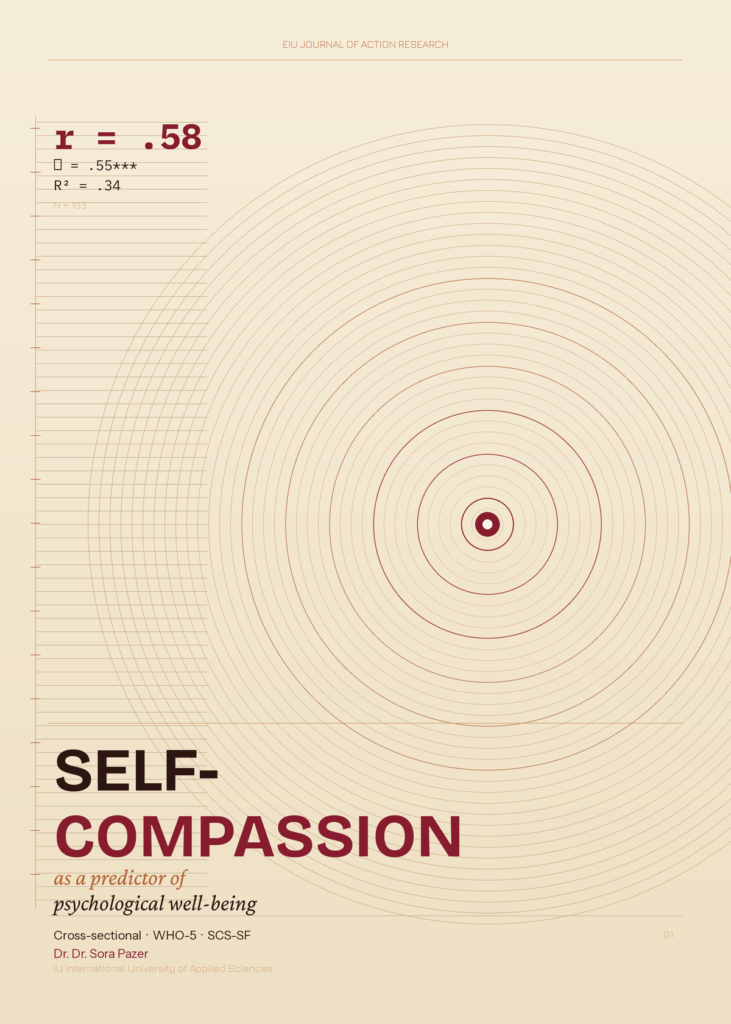
Main Results: Bivariate correlation revealed a strong positive association between self-compassion and psychological well-being, r(101) = .58, p < .001. In a multiple regression controlling for age and gender, self-compassion remained a significant predictor of well-being (β = .56, t = 6.82, p < .001), while age (β = .09, p = .334) and gender (β = -.06, p = .474) were non-significant. The overall model explained 34% of variance (R² = .34, Adjusted R² = .32, F(3, 99) = 17.01, p < .001).
Conclusion: Self-compassion is a robust predictor of psychological well-being in adults, independent of age and gender. Findings support the development of self-compassion-based interventions as a scalable approach to promoting population mental health.
Scroll to read the preview. Download for the complete document.
Cohen, J. (1988). Statistical power analysis for the behavioral sciences (2nd ed.). Lawrence Erlbaum Associates.
Deci, E. L., & Ryan, R. M. (2000). The “what” and “why” of goal pursuits: Human needs and the self-determination of behavior. Psychological Inquiry, 11(4), 227–268. https://doi.org/10.1207/S15327965PLI1104_01
Erikson, E. H. (1968). Identity: Youth and crisis. Norton.
Fredrickson, B. L. (2001). The role of positive emotions in positive psychology: The broaden-and-build theory of positive emotions. American Psychologist, 56(3), 218–226. https://doi.org/10.1037/0003-066X.56.3.218
Germer, C. K., & Neff, K. D. (2013). Self-compassion in clinical practice. Journal of Clinical Psychology, 69(8), 856–867. https://doi.org/10.1002/jclp.22021
Gilbert, P. (2010). Compassion focused therapy: Distinctive features. Routledge.
Gross, J. J. (2015). Emotion regulation: Current status and future prospects. Psychological Inquiry, 26(1), 1–26. https://doi.org/10.1080/1047840X.2014.940781
Hayes, S. C., Strosahl, K. D., & Wilson, K. G. (2012). Acceptance and commitment therapy: The process and practice of mindful change (2nd ed.). Guilford Press.
Krieger, T., Altenstein, D., Baettig, I., Doerig, N., & Holtforth, M. G. (2016). Self-compassion in depression: Associations with depressive symptoms, rumination, and avoidance in depressed outpatients. Behavior Therapy, 47(2), 169–180. https://doi.org/10.1016/j.beth.2015.11.004
Leary, M. R., Tate, E. B., Adams, C. E., Allen, A. B., & Hancock, J. (2007). Self-compassion and reactions to unpleasant self-relevant events: The implications of treating oneself kindly. Journal of Personality and Social Psychology, 92(5), 887–904. https://doi.org/10.1037/0022-3514.92.5.887
Neff, K. D. (2003a). The development and validation of a scale to measure self-compassion. Self and Identity, 2(3), 223–250. https://doi.org/10.1080/15298860309027
Neff, K. D. (2003b). Self-compassion: An alternative conceptualization of a healthy attitude toward oneself. Self and Identity, 2(2), 85–101. https://doi.org/10.1080/15298860309032
Neff, K. D., Kirkpatrick, K. L., & Rude, S. S. (2007). Self-compassion and adaptive psychological functioning. Journal of Research in Personality, 41(1), 139–154. https://doi.org/10.1016/j.jrp.2006.03.004
Podsakoff, P. M., MacKenzie, S. B., Lee, J. Y., & Podsakoff, N. P. (2003). Common method biases in behavioral research: A critical review of the literature and recommended remedies. Journal of Applied Psychology, 88(5), 879–903. https://doi.org/10.1037/0021-9010.88.5.879
Raes, F., Pommier, E., Neff, K. D., & Van Gucht, D. (2011). Construction and factorial validation of a short form of the Self-Compassion Scale. Clinical Psychology & Psychotherapy, 18(3), 250–255. https://doi.org/10.1002/cpp.702
Ryff, C. D. (1989). Happiness is everything, or is it? Explorations on the meaning of psychological well-being. Journal of Personality and Social Psychology, 57(6), 1069–1081. https://doi.org/10.1037/0022-3514.57.6.1069
Seligman, M. E. P. (2011). Flourish: A visionary new understanding of happiness and well-being. Free Press.
Topp, C. W., Østergaard, S. D., Søndergaard, S., & Bech, P. (2015). The WHO-5 Well-Being Index: A systematic review of the literature. Psychotherapy and Psychosomatics, 84(3), 167–176. https://doi.org/10.1159/000376585
World Health Organization. (1998). WHO (Five) Well-Being Index (WHO-5). Psychiatric Research Unit, WHO Collaborating Center for Mental Health.
World Medical Association. (2013). World Medical Association Declaration of Helsinki: Ethical principles for medical research involving human subjects. JAMA, 310(20), 2191–2194. https://doi.org/10.1001/jama.2013.281053
Yarnell, L. M., Stafford, R. E., Neff, K. D., Reilly, E. D., Knox, M. C., & Mullarkey, M. (2015). Meta-analysis of gender differences in self-compassion. Self and Identity, 14(5), 499–520. https://doi.org/10.1080/15298868.2015.1029966
Zessin, U., Dickhäuser, O., & Garbade, S. (2015). The relationship between self-compassion and well-being: A meta-analysis. Applied Psychology: Health and Well-Being, 7(3), 340–364. https://doi.org/10.1111/aphw.12051
Metrics are updated in real time as the article is accessed and downloaded.
Comments
Leave a Comment